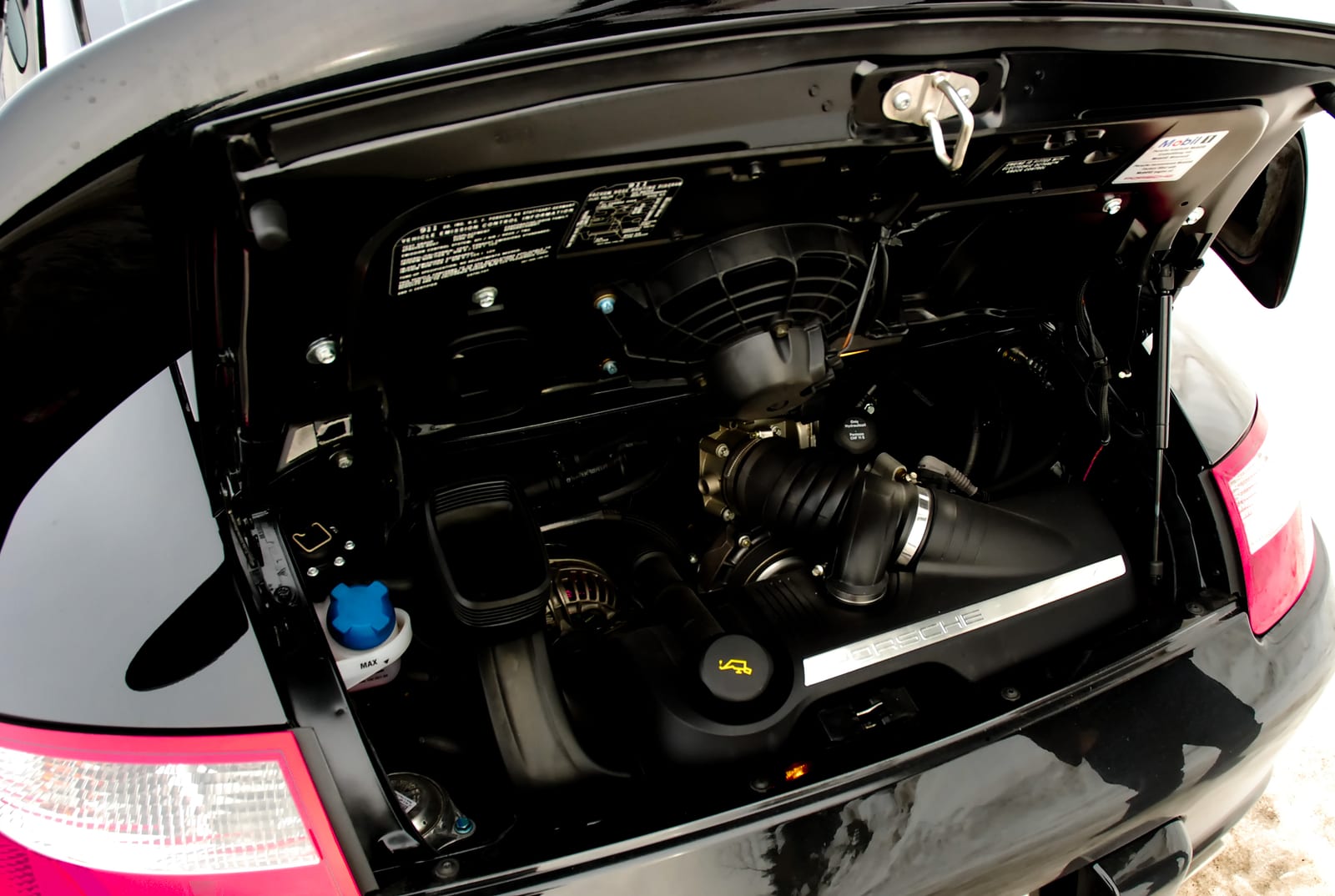
Data from a Rennlist owner thread, read in full on October 27, 2026. Last post counted: September 2, 2024.
The short answer
- We read all 1,160 posts in the long-running Rennlist thread that asks 997 owners whether their IMS bearing failed, and counted 419 first-hand owner reports.
- Owners reported 38 IMS failures and 7 more bearings caught shedding metal before they let go.
- 32 of the 38 failures and all 7 early catches were 2005 cars. Owners of 2006 to 2008 cars reported 6 failures across 224 reports, and no 2008 owner reported one.
- 997.2 cars (2009 to 2012) have no IMS bearing. Their 9A1 engine dropped the intermediate shaft.
- These are owners who chose to post. The numbers show patterns in what owners reported. They are not failure rates.
Since April 2011, Rennlist members have been logging their own cars in a poll thread that asks: did your IMS fail, yes or no, with year, generation and engine. Over 13 years it grew to 78 pages, and much of it is buying questions and long arguments.
This page pulls the owner reports out, counts them, and links each finding back to the post it came from. Thanks to the Rennlist members who posted about their cars. The thread is here: IMS failure for your 997 car, Y or N?.
It covers the Carrera, Carrera S, Carrera 4, Carrera 4S, Targa 4/4S and Cabriolet. The 997 Turbo, GT2 and GT3 use the Mezger engine, which LN Engineering says is not affected by this bearing problem, so they were left out.
Which 997 has which bearing
Porsche fitted the 997 Carrera with a 3.6-litre flat six and the Carrera S with a 3.8. The autumn 2008 update brought new direct-injection engines for the 997.2. In LN Engineering's terms, the 2005 to 2008 Carrera uses the M96 3.6 and the Carrera S the M97 3.8, and the 997.2 uses the 9A1, which has no intermediate shaft or IMS bearing.
| Model years | Generation | Engine | IMS bearing |
|---|---|---|---|
| Early 2005 builds | 997.1 | M96 3.6 / M97 3.8 | Smaller single-row bearing, replaceable with the transmission out |
| Later 2005 builds to 2008 | 997.1 | M96 3.6 / M97 3.8 | Larger bearing that needs engine disassembly to replace |
| 2009 to 2012 | 997.2 | 9A1 3.6 / 3.8 (direct injection) | None. No intermediate shaft |
2005 is a split year. LN Engineering lists the changeover by engine number: 3.6 engines before 69507475 and 3.8 engines before 68509791 should have the smaller single-row bearing. LN also warns that model year alone does not settle it and that a replacement engine may carry a different bearing, so a visual check is the only sure answer.
Sources: Porsche Newsroom, sixth-generation 911 engines; LN Engineering, IMS bearing type by engine serial number; LN Engineering, IMS bearing problem years.
Owner reports by model year
| Model year | Generation | Owner reports | IMS failed | Bearing caught early | Other engine failure | Share of reports with an IMS problem |
|---|---|---|---|---|---|---|
| 2005 | 997.1 | 157 | 32 | 7 | 1 | 25% |
| 2006 | 997.1 | 125 | 4 | 0 | 1 | 3% |
| 2007 | 997.1 | 63 | 2 | 0 | 0 | 3% |
| 2008 | 997.1 | 36 | 0 | 0 | 1 | 0% |
| 2009 to 2012 | 997.2 | 23 | 0 | 0 | 0 | no IMS fitted |
| Not stated | 997 | 15 | 0 | 0 | 3 | 0% |
| Total | 419 | 38 | 7 | 6 |
"Bearing caught early" means the owner found metal in the filter or a visibly failing bearing and replaced it before the engine let go. "Other engine failure" covers owners who said the engine failed for another reason, such as a thrust washer, crankshaft play or a cylinder.
IMS problems as a share of owner reports, by model year
2005 cars made up 157 of the reports and 32 of the 38 failures. The 2006 to 2008 cars, which have the larger bearing, produced 224 reports and 6 failures: 4 on 2006 cars and 2 on 2007 cars.
One 2006 owner found half the bearing missing during a clutch job at 117,000 miles on a car that had been running fine. Another 2006 failed at Road Atlanta at 55,000 miles. A 2007 C2S owner had a failure 120 miles after buying the car at 82,000 miles, and the dealer bought it back.
By engine
Where the engine was stated or could be inferred from the model, 2005 owners reported 12 failures on the 3.6 (M96) and 10 on the 3.8 (M97). The other 10 failures on 2005 cars did not say which engine. That is too few to say one engine did worse than the other.
Mileage
Reported failures happened at a median of 40,000 miles (35 reports with a mileage), ranging from 10,000 to 117,000 miles. Long-time members kept making the same point in the thread: there is no mileage after which an original small bearing is "safe."
Warning signs owners described
These are owner reports, not a diagnostic guide. Each links to the post.
- Metal in the oil filter. Several owners caught a failing bearing this way, including one who found 3 pieces of metal in the filter at 55,000 miles and another whose shop showed him metal particles in the cut-open filter.
- A rattle at start-up plus oil weeping near the rear main seal. One 2005 owner had small metal bits, weeping and a start-up rattle and replaced the bearing before it failed.
- Nothing at all. Many failures came with no warning. One owner had no signs at an oil change about 1,000 miles earlier. Another pulled into the garage after an 800-mile day, heard nothing, and found a pool of oil the next morning. LN Engineering notes the single-row bearing can fail with little or no warning.
How owners checked
- Cutting open the oil filter at every change was the most common check, and it is how most of the "caught early" cases were found. One owner also confirmed his failure by cutting open the filter.
- Oil analysis. Some owners sent samples to labs. One owner who later found metal in his filter said the lab report had not pointed to anything. LN Engineering says a standard analysis will not catch IMS bearing debris without a separate particle count.
- Checking the bearing type. 2005 owners often looked up their engine number or checked during a clutch job to see which bearing they had.
What owners did about it
Of the 45 IMS failures and early catches, owners said they fitted a replacement engine in 14 cases and had the engine rebuilt in 8. All 7 early catches ended with a new bearing and a running engine. 2 owners sold, traded or returned the car, and 12 did not say.
Warranty, CPO or Porsche goodwill came up in several of the 2005 cases, such as this CPO engine replacement and this goodwill engine a month out of CPO.
One 2005 owner's engine failed with an LN single-row retrofit bearing a previous owner had fitted. It is one report, and the thread does not show how common that is.
For 2006 to 2008 cars, where the bearing cannot be swapped without opening the engine, LN Engineering advises removing the bearing's grease seal so engine oil can reach it.
Parts mentioned in this guide
Only for 997s with the original single-row IMS bearing, which means early-build 2005 cars. 2006 to 2008 cars have the larger bearing and this kit does not apply. Confirm your bearing first.
- LN Engineering Single Row Pro IMS Retrofit kit with installation tools (ECS Tuning). ECS lists it for the 2005 997 Carrera and Carrera S, single-row bearing only.
Disclosure: this is an affiliate link. If you buy through it, Department 69 may earn a commission at no extra cost to you.
The class action, briefly
The IMS class action, Eisen v. Porsche Cars North America, received final approval in January 2014. It covered model year 2001 to 2005 911s built with an intermediate shaft between May 4, 2001 and February 20, 2005, excluding the Turbo, GT2 and GT3, within certain VIN ranges. That takes in early-build 2005 997s. It paid only for actual IMS damage, not preventive work, and only within 10 years of the car going into service or 130,000 miles. Reimbursement ran from 100% down to 40% by mileage for new and certified pre-owned buyers, and 25% for open-market used buyers. With the newest covered cars built in early 2005, that 10-year window has passed.
Source: Amended order granting final approval, Eisen v. Porsche Cars North America, C.D. Cal., Jan. 30, 2014.
What other forums report
The counts above come only from the Rennlist thread. Other forums have run their own polls. We kept them out of our counts and tables because they ask different questions and cover different cars. Like the Rennlist poll widget, they are owner votes. Voters choose to take part, so the results are not failure rates.
A PistonHeads thread started in September 2011 asks "Has your 996 or 997 engine had a major rebuild?" The poll is open to anyone, and the person who started it said it is multi-answer.
| PistonHeads poll answer | Votes |
|---|---|
| No | 511 |
| Yes, because of scored bores | 95 |
| Yes, because of the IMS | 66 |
| Yes, because of D chunk failure | 9 |
| Rebuilt before purchase, not sure why | 46 |
| Have not bought one because of known faults | 189 |
As shown on October 27, 2026. 903 members polled. Voters can pick more than 1 answer, so the votes add up to more than 903.
66 voters said their engine was rebuilt because of the IMS, and 95 said scored bores. The poll mixes the 996 and 997 and does not ask for model year, so it cannot show the 2005 split in the Rennlist reports. PistonHeads is a UK site. The 189 voters who never bought one have no engine to report on.
We did not find another forum poll on 997 IMS failures, outside Rennlist, with results we could open and check.
No IMS on a 997.2 does not mean no engine worries: the 9A1 can still score its bores, and so can the 997.1. See what 98 owner reports show about 997 bore scoring.
What this data cannot tell you
- A failure rate. This is not a random sample. Owners chose whether to post, and people with a failure post more. Never read "9% of reports" as "9% of 997s."
- How the cars were used. Short trips, long storage, oil choice and track time all come up in the thread, but too few owners gave enough detail to compare.
- Whether the diagnosis was right. These are owner reports. A handful of "yes" posts described an engine failure without naming the IMS as the cause.
- A direct comparison with other forums. The PistonHeads poll mixes the 996 and 997 and does not ask for model year, so its numbers cannot be set against the Rennlist counts.
- What happened after the post. A "no failure at 40,000 miles" report says nothing about 80,000 miles.
For context outside the thread, LN Engineering cites an approximately 8% failure rate for the smaller single-row bearing during the warranty period across 2000 to 2005 Porsches, and says itself that this is not a lifetime rate. LN also sells IMS parts.
How we counted
We downloaded all 78 pages on October 27, 2026 and read the posts. A report counted when an owner described the outcome for a 997 they own or owned, including documented history of their own car, such as dealer records of a failure under a previous owner. We left out second-hand stories, cars inspected for purchase but not bought, Turbos, GT3s, 996s, Boxsters and Caymans, jokes, and repeat posts about the same car. When an owner first reported "no problems" and later reported a failure on the same car, only the failure counted. Quoted text inside posts was removed before counting so the same report was not counted twice.
2 members tallied the thread themselves along the way. Up to the November 2017 tally, we counted 29 IMS failures in 328 owner reports. That member counted 28 in 320. Counts are a judgment call in places, and every row in our working file links back to its post. If you think we coded a post wrong, tell us and we will fix it.
The other-forum section is separate from our counts. None of its numbers are in any count, table or chart above. We opened each page on October 27, 2026 and took the figures as shown that day.
Sources
- Rennlist: IMS failure for your 997 car, Y or N? (thread started April 2011)
- PistonHeads: Has your 996 or 997 engine had a major rebuild? (poll, thread started September 2011)
- Porsche Newsroom: sixth-generation 911 engines
- LN Engineering: IMS bearing type by engine serial number
- LN Engineering: IMS bearing problem years
- Eisen v. Porsche Cars North America, final approval order (CourtListener)
More on the 997
- Porsche 997.1 Carrera buyer's guide: what to pay and what to check
- 997.1 torque specs for common maintenance and DIY jobs
- The 996 IMS bearing: risk, reality, and what to do about it
FAQ
What percentage of Porsche 997s have an IMS failure?
No public data gives a reliable rate. In the Rennlist owner thread, 38 of 419 owner reports described an IMS failure, but owners chose to post, so that is not a failure rate. 32 of those failures were 2005 cars.
Does the 997.2 have an IMS bearing?
No. The 2009 to 2012 997.2 uses the 9A1 engine, which has no intermediate shaft, so there is no IMS bearing.
Which 997 years have the larger IMS bearing?
2006 to 2008 997.1 cars have the larger bearing. 2005 is a split year. LN Engineering lists 3.6 engines before number 69507475 and 3.8 engines before 68509791 as having the smaller single-row bearing, and recommends a visual check because replacement engines can differ.
Do 2006 to 2008 997s have IMS failures?
Fewer were reported. In the Rennlist thread, owners of 2006 to 2008 cars reported 6 failures in 224 reports: 4 on 2006 cars and 2 on 2007 cars, and none for 2008. LN Engineering says the larger bearing is more robust but not immune.
Can oil analysis detect a failing IMS bearing?
Not reliably on its own. LN Engineering says a standard used oil analysis will not identify a failing IMS bearing without a separate particle count. Owners in the thread more often caught problems by cutting open the oil filter.