Some links in this article go to car listing and parts sites. Some of them may be affiliate links, which means Department 69 may earn a commission at no extra cost to you. Details are in our privacy policy.
Prices checked October 22, 2026.
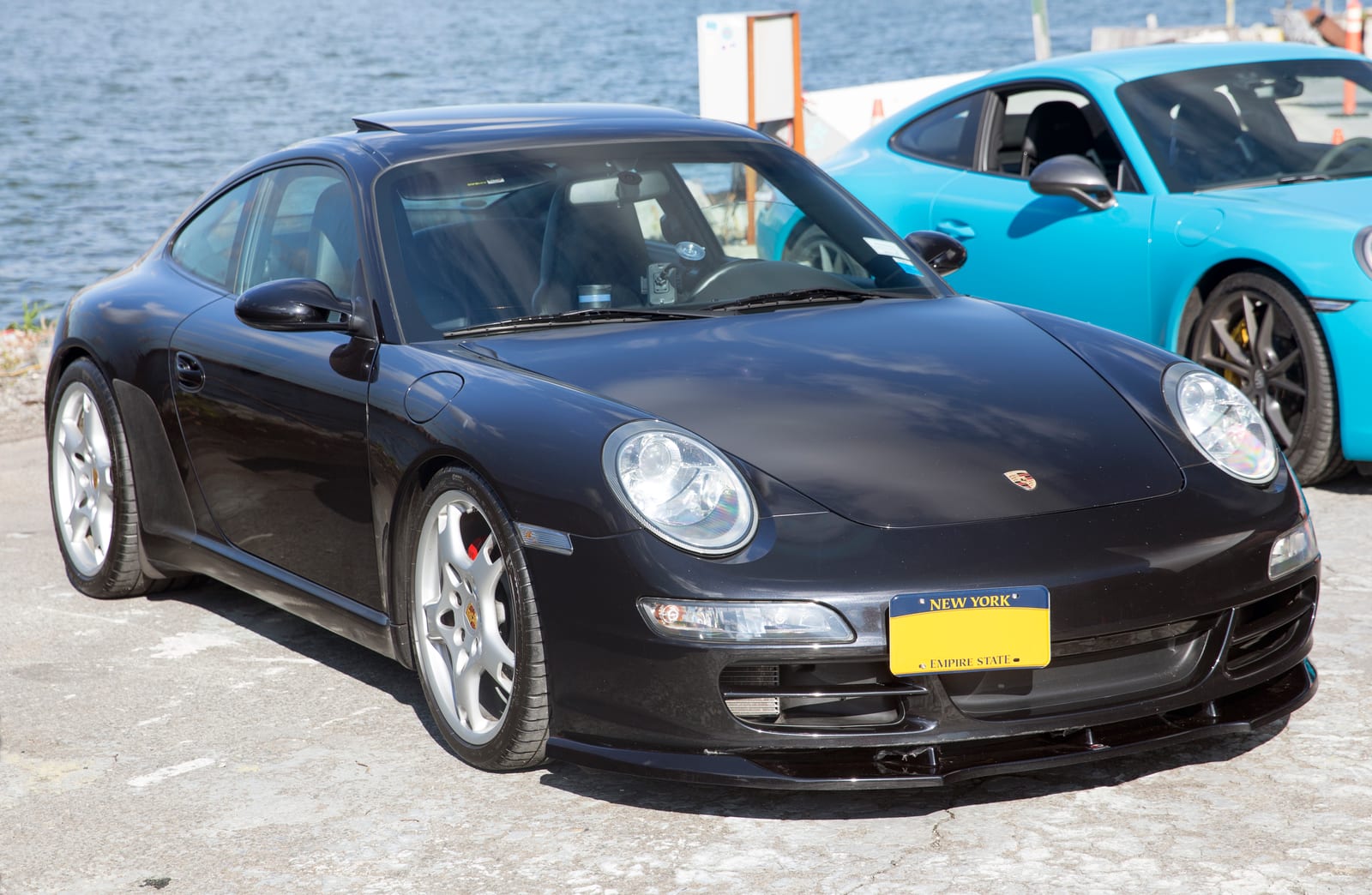
The 997.1 is the 2005 to 2008 Porsche 911 Carrera. It brought back round, clear-glass headlights after the 996. Prices have climbed this year, and the engine still has known weak points. This guide covers what cars are selling for now, which versions to look for, the problems that matter, and what to check before you hand over money.
This guide covers the Carrera, Carrera S, Carrera 4, Carrera 4S, Cabriolet and Targa. The Turbo, GT2 and GT3 use a different engine and are left out.
The short version
- A Carrera S coupe with a manual has a market benchmark of about $52,700 on classic.com. Tiptronic cars sell for much less.
- Every 2006 to 2008 car has the larger IMS bearing. A 2005 needs its engine number checked.
- Bore scoring is the bigger worry on these engines. A borescope inspection is the way to rule it out.
- Get the DME over-rev report on any manual car before you buy.
The basics
The 997.1 Carrera and Carrera S were sold from the 2005 through 2008 model years. The Carrera uses a 3.6-litre flat six with 325 PS. The Carrera S uses a new 3.8-litre engine with 355 PS. From the 2006 model year, Porsche offered a power increase to 381 PS for the 3.8-litre S models, sold as the X51 Powerkit. Both came with a six-speed manual or a Tiptronic S automatic.
The Carrera S got PASM adaptive dampers as standard, along with red four-piston monobloc calipers and 330 mm perforated discs. PASM was an extra-cost option on the base Carrera. The all-wheel-drive Carrera 4 and 4S have rear haunches 44 mm wider than the rear-drive cars.
Sources: Porsche Newsroom, sixth-generation 911 engines; Porsche Classic, 911 Carrera (type 997); Hagerty 997 buyer's guide.
What to pay now
The table below uses classic.com's market benchmark (CMB). It is based on recent sales and is updated as cars sell. Treat each figure as a midpoint. Mileage and condition move individual cars well above or below it, as the recent sales further down show.
| Model | Coupe, manual | Coupe, Tiptronic | Cabriolet, manual | Cabriolet, Tiptronic |
|---|---|---|---|---|
| Carrera | $42,781 | $32,857 | $38,127 | $37,756 |
| Carrera S | $52,673 | $37,882 | $46,579 | $41,542 |
| Carrera 4S | $55,547 | $40,643 | $49,595 | $36,113 |
| Carrera 4S Targa | $64,992 | $53,260 | n/a | n/a |
| Model | Coupe | Cabriolet | Targa |
|---|---|---|---|
| Carrera 4 (classic.com does not split by gearbox) | $47,211 | $38,483 | $55,758 |
Source: classic.com 997 market data and the 997.1 Carrera S coupe manual page, checked October 22, 2026. Values cover 2005 to 2008 cars and move as new sales come in.
What Hagerty says
Hagerty's valuation tool puts a 2006 Carrera S coupe in #3 (good) condition at about $57,500, with a range of $50,000 to $60,567. That value is up 36.9% over the past year. Hagerty's buyer's guide says excellent six-speed coupes are "well into the $50,000 range."
Source: Hagerty valuation tool, 2006 911, October 2026.
Recent sales
| Car | Miles | Where | Date | Price |
|---|---|---|---|---|
| 2006 Carrera S coupe, manual | 16k | Bring a Trailer | Sept 11, 2026 | $106,047 |
| 2006 Carrera S coupe, manual | 53k | Bring a Trailer | Sept 12, 2026 | $80,850 |
| 2006 Carrera S coupe, manual | 38k | Bring a Trailer | Oct 1, 2026 | $70,350 |
| 2006 Carrera S coupe, Tiptronic | 83k | Cars & Bids | Oct 14, 2026 | $32,813 |
Source: past 2006 Carrera S sales listed in the Hagerty valuation tool, checked October 22, 2026.
Manual or Tiptronic
The gearbox is the single biggest price factor. On classic.com, a manual Carrera S coupe benchmarks about $14,800 above a Tiptronic one. The gap is about $9,900 on a base Carrera coupe and about $14,900 on a Carrera 4S coupe. The recent sales above show the same pattern: a 38k-mile manual Carrera S coupe brought $70,350, while an 83k-mile Tiptronic sold for $32,813.
If you want the lowest entry price, a Tiptronic coupe or cabriolet is the way in. If you plan to sell later, a manual will hold value better on current data.
Which years and options to look for
Years
The IMS bearing is the main reason year matters. LN Engineering says all 2006 to 2008 engines have the larger bearing, which has the same load rating as the earlier dual-row bearing. The 2005 model year is a transition year. Early 2005 engines have a single-row bearing, which Hagerty says had the highest failure rate. Mid-2005 cars moved to the larger one. If you are looking at a 2005, check the engine number before you go further (see the checklist below).
Options worth paying for
- Carrera S over Carrera. The S gets the 3.8, PASM, the bigger brakes and twin round tailpipes as standard.
- X51 Powerkit. Offered on 3.8-litre S models from the 2006 model year, it raises output to 381 PS. classic.com rates it at 376 hp.
- PASM on a base Carrera. It was an extra-cost option, so check the build sheet if you want it.
- Six-speed manual. See the price gap above.
Sources: LN Engineering, MY06-08 IMS bearing; Porsche Newsroom; Porsche Classic; Hagerty.
Known problems
IMS bearing (M96 and M97 engines)
The intermediate shaft bearing supports the shaft that drives the timing chains. Pelican Parts explains that oil and debris can get past the bearing's seal and wash out its grease. When it fails, the timing chains can lose sync and the engine can destroy itself.
On the 997.1, the risk depends on which bearing the engine has:
- 3.6 (M96.05): LN Engineering lists the single-row serviceable bearing up to engine number 69507475. After that, engines have the larger bearing.
- 3.8 (M97.01): the single-row bearing runs up to engine number 68509791. After that, engines have the larger bearing.
- All 2006 to 2008 engines have the larger bearing. LN says it can be identified by its 22 mm nut.
The larger bearing cannot be replaced without taking the engine apart. Hagerty notes that its failure is rare. LN recommends removing the bearing's grease seal, and Hagerty quotes LN's Charles Navarro suggesting this be done at clutch time. If the engine number contains an X or AT, LN says it is a Porsche replacement engine, and it carries whatever bearing was current in the year it was built. Hagerty puts the cost of an IMS failure at a rebuild of $25,000 or more.
For background, read our 996 IMS bearing explainer and our look at IMS solutions for the 986 and 987.
Sources: LN Engineering, which IMS bearing does my engine have; Pelican Parts, common 996/997 engine problems; Hagerty.
Bore scoring
Bore scoring is damage to the cylinder walls and piston skirts. LN Engineering says every 1999 to 2008 Carrera engine can suffer from it, and that the 3.6 and 3.8 are the most affected. Hagerty calls it the M97's other weak point and says, based on reports, it shows up more often on the 3.8.
Warning signs include rising oil use, a ticking or piston-slap sound at idle, and one sooty tailpipe. LN notes the ticking is sometimes mistaken for lifter noise. A borescope inspection is the most direct way to confirm it. Oil analysis and an oil filter check add supporting evidence. The fix is an engine rebuild with new cylinder sleeves.
Hagerty's advice for owners is to drive off soon after a cold start and stay under 3,000 rpm until the engine is warm.
Sources: LN Engineering, what is bore scoring; Hagerty.
Rear main seal (RMS)
A leaking rear main seal shows up as oil at the joint between the engine and transmission. Pelican Parts says the problem was mostly cosmetic unless the leak got bad enough to reach the clutch. Pelican also notes that some leaks blamed on the RMS actually come from the IMS cover.
Porsche revised the seal several times and settled on a PTFE seal, first as part 997 101 212 00. LN Engineering lists 0PB 105 249 as the current version as of March 2020. LN says the PTFE seal works in most engines when it is installed to the right depth with the factory tool. Engines with chronic leaks were usually machined wrong at the factory. Pelican calls the RMS the flywheel seal, and its guide pairs the job with a clutch replacement.
Sources: LN Engineering, M96/M97 failures and solutions; Pelican Parts.
Coolant pipes and the cooling system
The well-known failure of glued coolant pipes applies to the 997 Turbo and its Mezger engine. Hagerty is clear that it does not apply to the Carrera.
The Carrera's cooling system still has wear items. LN Engineering recommends changing the water pump every 4 to 5 years or 60,000 miles, because its plastic impeller can crack and send debris into the cylinder heads. LN also flags plastic coolant expansion tanks that crack with age. Look for dried coolant around the tank.
Sources: Hagerty; LN Engineering.
Air oil separator (AOS)
The AOS pulls oil vapor out of the crankcase and returns it to the sump. When its diaphragm fails, crankcase vacuum rises and oil can be pulled into the intake. In the worst case, enough oil reaches a cylinder to hydrolock the engine and bend a connecting rod.
On the 996 and 997, LN says a failing AOS often makes little or no smoke, so it can go unnoticed. Other signs include a lean-running check engine light and a honking sound from air being pulled past the crankshaft seals. The only firm test is a crankcase vacuum reading with a manometer. LN gives a normal M96 and M97 reading of about 4 to 6 inches of water. A failed unit can read 10 to 15 inches or more. LN treats the AOS as a maintenance item and recommends replacing it with a genuine Porsche part every 6 years or 75,000 miles.
Source: LN Engineering, AOS.
Ignition coil packs
Coil packs crack from heat and water exposure, which leads to misfires. LN Engineering says to inspect them for cracks or carbon tracking at every spark plug change. Porsche's interval for plugs is 4 years or 48,000 miles. When coils are replaced, LN says to use the latest revision, part 997 602 107 03. A misfire on the test drive is often just a coil, but get it diagnosed before you assume that.
Source: LN Engineering.
Pre-purchase inspection checklist
Hagerty recommends a pre-purchase inspection (PPI) by a Porsche specialist on every 997. Here is what to ask the shop to cover.
- Engine number. Read it off the engine and compare it with LN Engineering's cutoffs above. Look for an X or AT, which marks a factory replacement engine.
- DME over-rev report. The engine computer logs over-rev events in six ranges, plus the engine operating hours at the last event. For the 997 Carrera, LN lists them as follows:
- Range 1: above 7,300 to below 7,500 rpm
- Range 2: 7,500 to 7,700 rpm
- Range 3: 7,700 to 7,900 rpm
- Range 4: 7,900 to 8,400 rpm
- Range 5: 8,400 to 9,500 rpm
- Range 6: above 9,500 rpm
- Borescope of all six cylinders to check for bore scoring.
- Oil analysis and an oil filter inspection for metal and other debris.
- Crankcase vacuum test with a manometer to check the AOS. Expect about 4 to 6 inches of water.
- Cold start and idle. Listen for ticking or piston slap. Look at both tailpipes for one that is sootier than the other.
- Leaks at the engine to transmission joint, which point to the RMS or the IMS cover.
- Coil packs for cracks, and a scan for stored misfire codes.
- Cooling system. Look for dried coolant on the expansion tank and ask when the water pump was last changed.
- Camshaft deviation values, which Pelican Parts suggests reading during a PPI along with the oil filter.
- Service records. Look for AOS, water pump, plug and coil dates. Ask about oil use. LN cites Porsche bulletins that allow up to 1.6 quarts per 622 miles on these engines. LN also says most owners do not need to add oil between oil changes.
Hagerty also suggests joining the Porsche Club of America before you shop.
Sources: LN Engineering, over-rev ranges guide (data as of 2018); LN Engineering, AOS; LN Engineering; Pelican Parts; Hagerty.
After you buy
These Department 69 guides cover the jobs most new 997.1 owners do first: