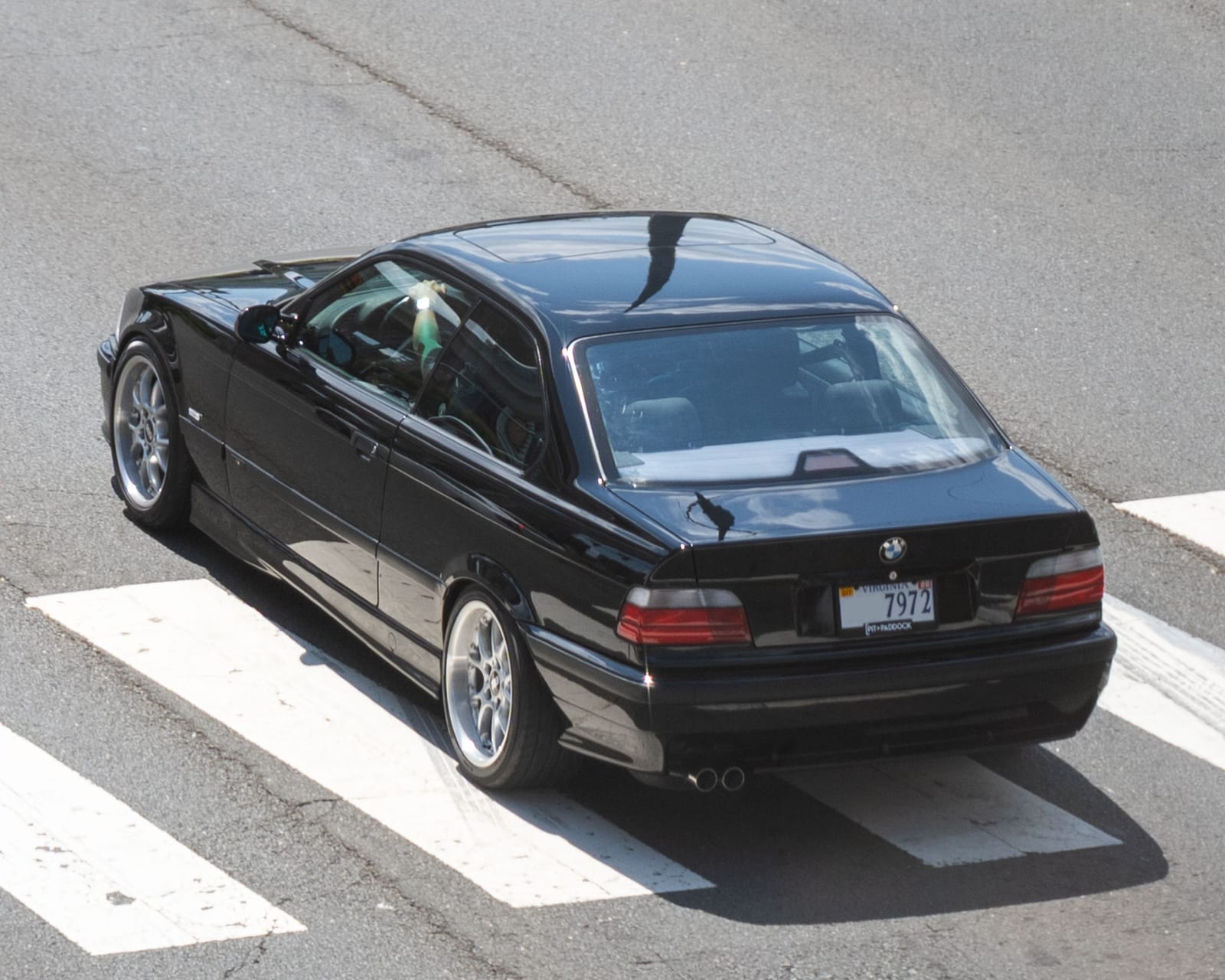
The thermostat decides when coolant flows to the radiator. When it sticks, an E36 either runs cold or overheats. Replacing it means removing the fan, draining coolant, swapping the thermostat and seals, then bleeding the air out. This guide covers the six-cylinder E36 3 Series sold in the US: the 325i and 325is (M50), the 323i and 328i (M52), and the M3 (S50 and S52). Every torque value, part number and temperature below comes from BMW's own repair data (TIS) or BMW's parts catalog (ETK), with a link to the page we read it on.
Not for four-cylinder cars. The 318i, 318is and 318ti (M42 and M44) use a different thermostat, a different housing and their own cooling circuit in BMW's repair data. This guide does not cover them. See BMW's separate four-cylinder coolant circuit and the separate M42 housing and M44 thermostat part numbers.
Affiliate disclosure: This article contains affiliate links. If you purchase through them, Department69 may earn a commission at no additional cost to you.
Safety: Work on a cold engine only. BMW warns of scalding and says to open the sealing cap only after the engine has cooled down. BMW TIS 17 00 039.
Symptoms of a failed E36 thermostat
A thermostat fails in one of two ways. DENSO, which makes thermostats for carmakers, lists these signs:
- Stuck open: the engine is slow to warm up, the temperature gauge stays below its normal spot, and the heater is weak.
- Stuck closed: coolant cannot reach the radiator, so the temperature climbs fast, often under load.
- Unstable readings: a gauge that rises and falls while you drive can point to a thermostat that is sticking.
Source: DENSO thermostat diagnosis guide. Turner Motorsport notes that BMW thermostats typically fail wide open, and that the plastic thermostat cover on these cars is a known point of failure that can crack and leak. Turner E36 thermostat notes. DENSO also notes these symptoms are often blamed on the radiator, fans, water pump or heater parts, so look at the whole system before you buy parts.
Which thermostat your engine uses
BMW stamps the opening temperature on the thermostat. BMW's technical data lists these values:
| Engine | E36 models (US) | Opening temp (BMW TIS) |
|---|---|---|
| M50 B25, non-VANOS | 325i, 325is | approx. 80 °C TIS |
| M50 B25 VANOS | 325i, 325is | approx. 92 °C TIS |
| M52 B25 | 323i, 323is | approx. 92 °C TIS |
| M52 B28 | 328i, 328is | approx. 92 °C TIS |
| S50US B30 | M3 3.0 | approx. 92 °C TIS |
| S52 B32 | M3 3.2 | approx. 92 °C TIS |
Not sure which M50 you have? Go by the number stamped on your old thermostat. BMW's parts catalog does not always match that table. For US cars it lists the 92 °C thermostat for the 325i, 328i and M3 3.0, with an 88 °C part for cars built up to 12/1995, and it lists the 88 °C part for the US M3 3.2. The simplest rule: read the number stamped on your old thermostat and order the part number for your VIN.
Parts needed
Part numbers below are from BMW's parts catalog (ETK) for US E36 cars. The housing and seals are the same across all four engines.
| Part | BMW part number | Notes |
|---|---|---|
| Thermostat, 92 °C | 11 53 7 511 083 | Listed for US 325i (M50), 328i (M52) and M3 (S50). 325i, 328i, M3 S50 |
| Thermostat, 88 °C | 11 53 7 511 580 | Listed for the US M3 (S52), and for the cars above built up to 12/1995. M3 S52 |
| Thermostat O-ring, 60 x 3.5 mm | 11 53 1 265 084 | Seals the thermostat in the head. Replace it. |
| Housing profile gasket | 11 53 1 740 437 | Seals the housing to the head. Replace it. |
| Thermostat housing | 11 53 1 722 531 | Optional. Replace it if it is cracked or leaking. |
| Housing bolts | 11 53 1 740 317 (M6 x 25, qty 3), 11 53 1 740 316 (M8 x 30, qty 1) | Both shown as discontinued in the catalog. Reuse good bolts. |
| Coolant | BMW-approved antifreeze | BMW says to use only coolant approved in its Operating Fluids spec, group 17. TIS 17 00 005 |
Parts and tools for this job
- Genuine BMW 92 °C thermostat (11537511083) at Turner Motorsport. Turner lists fitment for the E36 325i, 323i, 328i and M3 S50. Not listed for the S52.
- Genuine BMW thermostat housing gasket (11531740437) at Turner Motorsport, listed for M50, M52, S50 and S52.
- Genuine BMW thermostat housing (11531722531) at Turner Motorsport, listed for E36 M50, M52, S50 and S52.
- Tools: torque wrenches that cover 2.5 Nm to 40 Nm, a drain pan, and a way to hold the water pump pulley and turn the fan nut. BMW uses special tools 11 5 030 and 11 5 040 for the fan.
Torque specs
| Fastener | Torque | BMW source |
|---|---|---|
| Thermostat housing bolts, M6 | 10 Nm / 89 in-lb | TIS 11 53 1AZ. Same value in the M50, M52, S50US and S52 tables |
| Bleed screw, thermostat housing (M8, 8 mm across flats) | 8 Nm / 71 in-lb | TIS 11 53 2AZ and 17 00 2AZ |
| Fan clutch to water pump, coupling nut (left-hand thread) | 40 Nm / 30 ft-lb | TIS 11 52 1AZ |
| Fan to fan clutch | 10 Nm / 89 in-lb | TIS 11 52 2AZ |
| Radiator drain plug | 2.5 Nm / 22 in-lb | TIS 17 11 2AZ |
| Engine block coolant drain plug, M14 x 1.5 | 25 Nm / 18 ft-lb | TIS 11 11 5AZ |
| Hose clamps, 32 to 48 mm | 2.5 Nm / 22 in-lb | TIS 17 00 1AZ |
Imperial values are converted from the BMW Nm figures and rounded. BMW's 11 53 table lists only the M6 housing bolts and the bleed screw. It gives no separate value for the single M8 bolt, so we do not print one. The thermostat repair page points to "Technical Data 11 11 5AZ", which in this TIS copy is the block drain plug value, so use the 11 53 table above for the housing.
Step-by-step replacement
These steps follow BMW's procedure for the M52 and S52 (TIS 11 53 000, page 1 and page 2). BMW's M50 housing pages give the same installation notes (M50, M50 VANOS).
- Let the engine cool fully. Open the expansion tank cap only when cold.
- Remove the fan clutch with the fan, and the fan cowl. The coupling nut has a left-hand thread. BMW holds the pulley with tool 11 5 030 and turns the nut with tool 11 5 040. TIS 11 52 020.
- Drain the coolant. Remove the front underbody cover if needed and open the drain plug at the bottom of the radiator. On six-cylinder engines BMW also lists a drain plug on the engine block. Fit new gaskets on both plugs when you refit them. TIS 17 00 005.
- Disconnect the water hoses from the thermostat housing.
- Remove the lifting eye (BMW calls it the suspension eye) and, on the M52 and S52, the cable channel.
- Unbolt the thermostat housing and pull the old thermostat out of the head. Check the number stamped on it.
- Clean the sealing faces. BMW says they must be clean and free of oil.
- Fit the new thermostat with a new O-ring. Install it with the vent hole or arrow facing up.
- Fit a new housing gasket and refit the housing. Torque the M6 bolts to 10 Nm.
- Refit the lifting eye, cable channel and hoses. Hose clamps in the 32 to 48 mm range are 2.5 Nm.
- Refit the fan and fan clutch. Fan to clutch is 10 Nm. The clutch nut is 40 Nm, left-hand thread. BMW notes that with tool 11 5 040 on the wrench, 30 Nm on the torque wrench scale equals 40 Nm at the nut. TIS 11 52 020, page 2.
- Refit the drain plugs (radiator 2.5 Nm, block 25 Nm), then fill and bleed as below.
Bleeding the cooling system after
The M50 and M52 cooling circuit uses an integral expansion tank (BMW coolant circuit, M50 and M52). For that layout BMW says to bleed through the vent screw on the expansion tank, and on M52 engines to also open the additional vent screw. TIS 17 00 005, page 3.
- Set the heater first. Switch the ignition on, set the heater to maximum temperature and the fan to low. BMW says this opens the heater valves and runs the auxiliary water pump if fitted.
- Open the bleed screw(s). Expansion tank vent screw, plus the extra vent screw on M52 engines.
- Fill slowly. Fill the expansion tank completely and wait until coolant comes out of the vent points with no bubbles. Close the bleed screws. The thermostat housing bleed screw is 8 Nm.
- Purge with the cap off. Start the engine and give it three or four short bursts of throttle to about 4,500 to 5,000 rpm. Do not run it longer than about 30 seconds, so the coolant does not heat up and expand. If the level drops, top the tank up to the brim. TIS 17 00 039.
- Warm it up. Fit the cap and run the engine until the thermostat opens. Watch for leaks.
- Check the level cold. Let the coolant drop to 30 °C or below (or to ambient if it is hotter than 30 °C outside), then top up to the mark on the tank. BMW notes the mark shows the level at about 20 °C. TIS 17 00 039, page 2.
For reference, BMW lists the full E36 system capacity, including the heater, as 10.0 liters for the M52 and 10.5 liters for the M50 (11.0 liters with integrated air conditioning). BMW's E36 cooling system test pressure is 1.0 bar if you pressure test for leaks after. M52 data, M50 data.
Frequently asked questions
Which way does the thermostat go in?
BMW says to install it with the vent hole or arrow facing up. TIS 11 53 000.
Do I have to remove the fan?
Yes. BMW's thermostat procedure for the M52 and S52 starts with removing the fan clutch, fan and fan cowl. TIS 11 53 000.
Should I fit a lower-temperature thermostat?
Turner Motorsport, which sells them, says changing the thermostat temperature is not recommended to fix failures in the cooling system. Use the rating BMW specifies for your engine. Turner.
Does this guide work for a 318i?
No. The four-cylinder M42 and M44 cars use different parts and a different procedure.
More E36 work: our E36 torque specs, the E36 common problems guide, and engine references for the M50 and M52.
Sources
- BMW TIS 11 53 000, removing and installing coolant thermostat (M52/S52), page 1 and page 2.
- BMW TIS, removing thermostat housing (M50) and replacing thermostat housing cover (M50 VANOS).
- BMW TIS 11 52 020, fan clutch removal, page 1 and page 2.
- BMW TIS tightening torques: 11 53 (M52), 11 53 (M50), 11 53 (S50US), 11 53 (S52), 11 52, 17 00, 17 11, 11 11.
- BMW TIS technical data, thermostat opening temperature: M50 B25, M50 B25 VANOS, M52 B25, M52 B28, S50US, S52.
- BMW TIS coolant data: E36 M52 and E36 M50; coolant circuit (M50, M52).
- BMW TIS 17 00 005, draining and topping up coolant: page 2 and page 3. BMW TIS 17 00 039, bleeding: page 1 and page 2.
- BMW ETK via RealOEM, waterpump and thermostat: US 325i, US 328i, US M3 S50, US M3 S52.
- DENSO, thermostat diagnosis.
- Turner Motorsport, E36 thermostats.
Technical disclaimer: This is an independent DIY reference, not a substitute for BMW's current repair information for your VIN. Production changes affect parts and procedures. Work on a cold engine and at your own risk.