BMW M52 vs. M52TU vs. M54: How to Tell Them Apart
The M52, M52TU and M54 look related because they are. But single vs. double VANOS, throttle design, engine management and block exceptions matter when identifying an engine or buying parts. This guide uses BMW training documents to separate them.
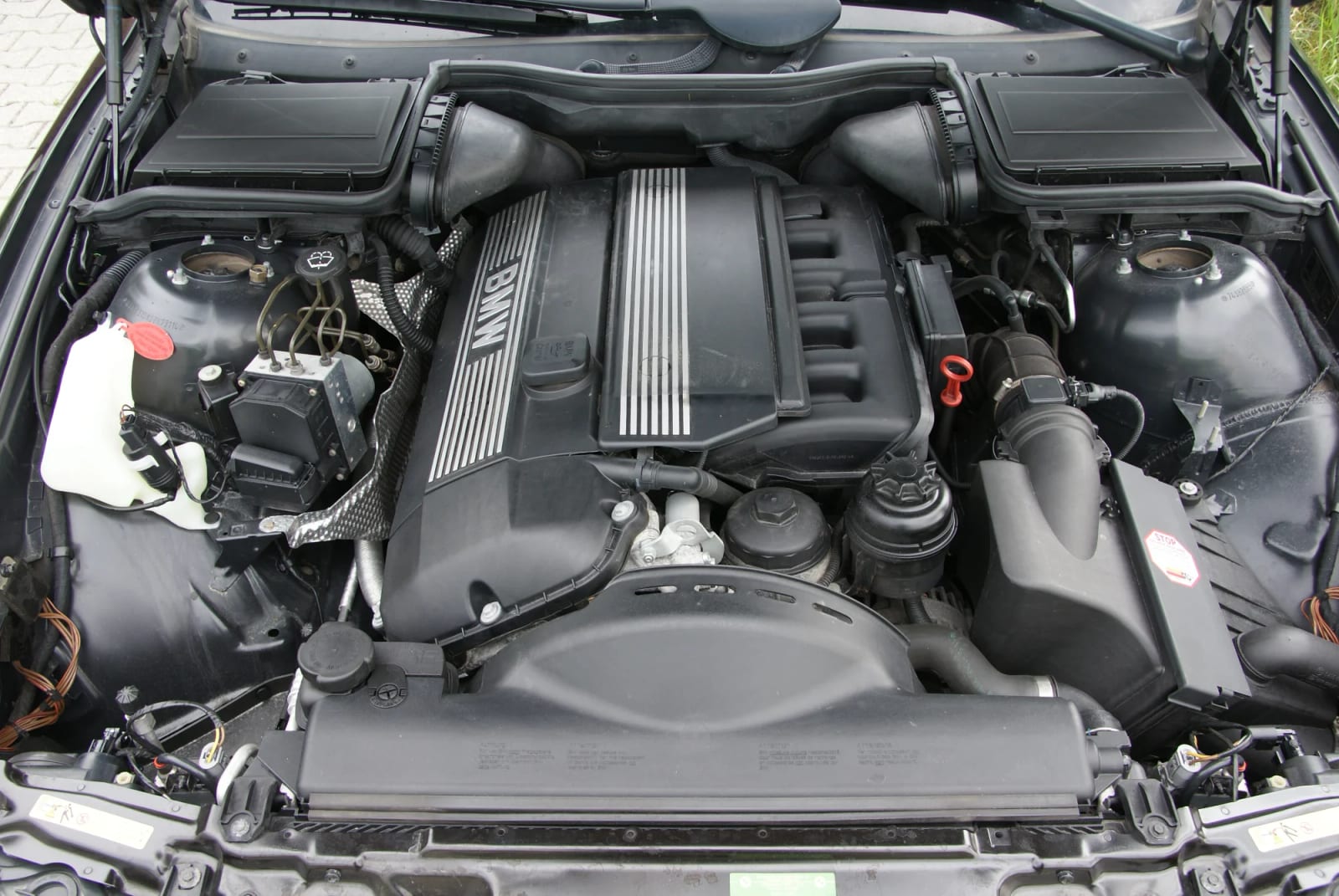
The BMW M52, M52TU, and M54 are related inline-six engines, but they are not interchangeable names. That distinction matters when you order a VANOS gasket, identify the engine-management system, or follow a repair procedure. An E46 328i and an E46 330i can both have double VANOS, for example, yet they do not have the same engine.
This guide focuses on identifying the three engine families, especially the U.S.-market E36, E46, E39, and Z3 applications. It is an identification reference, not a substitute for a VIN-specific parts catalog or factory repair instructions. BMW's own engine training material is the main source throughout.
Quick comparison: M52 vs. M52TU vs. M54
| Feature | Original M52 | M52TU | M54 |
|---|---|---|---|
| VANOS | Single VANOS, intake camshaft | Double VANOS, intake and exhaust | Double VANOS, intake and exhaust |
| Engine management (typical U.S. applications) | Siemens MS41 family | Siemens MS42 | Siemens MS43 (early applications; confirm by vehicle) |
| Throttle system | Mechanical throttle linkage | Motor-driven throttle valve (MDK) | Fully electronic throttle control |
| Variable-length intake | Not the M52TU-style resonance/turbulence manifold | Resonance/turbulence intake system | Revised resonance/turbulence intake system |
| Block construction | Market/application dependent; U.S. E36/E39 commonly cast iron, Z3 2.8 an important aluminum-block exception | Aluminum crankcase with iron cylinder liners in BMW's training example | Developed from M52TU architecture; verify specific engine variant |
| Representative U.S. models | E36 328i; earlier E39 528i; earlier Z3 2.8 | E46 323i/328i; later E39 528i; later Z3 2.8 | E46 325i/330i; E39 525i/530i; later Z3 2.5i/3.0i |
Source: BMW engine-training material, particularly the M52TU overview, VANOS section, M54 introduction, and mechanical-changes sections. Model examples are not an exhaustive fitment list. Read the BMW training document (PDF).
The fastest way to identify which engine you have
- Start with the engine code, VIN, and production date. Model badges are useful clues, not definitive proof, particularly around changeover periods or on swapped cars. Check the vehicle-specific engine designation in a reliable BMW parts or service lookup.
- Look at the VANOS assembly at the front of the cylinder head. An original M52 uses single VANOS, while M52TU and M54 use double VANOS. This is a useful visual distinction between original M52 and the two later engines, but double VANOS alone cannot separate M52TU from M54.
- Distinguish M52TU from M54 using throttle control and engine electronics. BMW training identifies the M52TU's MS42 management and motor-driven throttle arrangement. The M54 training describes fully electronic throttle control and MS43 management. These are stronger clues than simply counting VANOS solenoids.
- Verify the specific part against the exact engine and chassis. Do not assume that a part sold as fitting an “M52” also fits the M52TU. The suffix is meaningful.
What changed from the M52 to the M52TU?
BMW's M52TU training lists a redesigned crankcase, revised cooling system, map-controlled thermostat, motor-driven throttle valve, and double VANOS among the updates. The TU stands for Technical Update, not a minor calibration change. BMW M52TU training, overview and crankcase sections.
Single VANOS vs. double VANOS
The original M52 adjusts intake-cam timing using a single-VANOS system. The M52TU adds variable control of the exhaust camshaft as well. BMW describes the M52TU system as continuously adjustable within its mechanical limits, with oil pressure directed through solenoid valves. The goal was better torque characteristics, idle behavior, fuel economy, and emissions control. BMW training, VANOS and double-VANOS operation sections.
For DIY work, the practical consequence is straightforward: do not carry over a single-VANOS M52 procedure or parts list to an M52TU simply because the engine cover or chassis looks similar.
Block-material caveat
It is tempting to say “M52 equals iron block” and “M52TU equals aluminum block.” That is too broad. BMW's training explicitly notes that the M52TU aluminum crankcase uses the same alloy as the Z3 Roadster 2.8-liter M52 crankcase, while comparing its weight with the cast-iron M52 block. The Z3 example is why a universal M52 block-material rule is unsafe. BMW training, crankcase section.
This is particularly important when working with cylinder-head fasteners or buying engine internals. Confirm the actual block and engine variant before applying any torque-angle procedure. This article deliberately does not give a universal head-bolt specification.
What changed from the M52TU to the M54?
The M54 was an evolution of the M52TU rather than a return to the earlier single-VANOS layout. BMW's M54 training identifies changes to the pistons and rings, crankshaft on the 3.0-liter version, camshaft on the 3.0-liter version, intake manifold, and engine management. The M54 retained double VANOS. BMW training, M54 introduction and mechanical changes.
Electronic throttle and engine management
The most useful distinction for identification is that the M54 uses fully electronic throttle control. Its engine-management architecture also changed from the M52TU's MS42 to MS43 in the applications covered by BMW's training. A later car's exact control unit should still be verified before ordering electronics or using diagnostic instructions. BMW M52TU/M54 training transcript.
Why M54B25 and M54B30 should not be treated as identical
Even within the M54 family, displacement matters. BMW's training says the 3.0-liter M54 uses a crankshaft derived from the S52B32 and a camshaft with increased lift, while the 2.5-liter M54 retains the corresponding M52TU crankshaft and camshaft designs. The intake manifold was revised for both. A “fits M54” listing is not enough when a component is displacement-specific. BMW training, M54 mechanical changes.
Production dates: use them as clues, not universal rules
For the E46 models discussed in BMW's training module, the M52TUB28 is listed from June 1998 through June 2000 production and the M52TUB25 from June 1998 through September 2000. The training identifies the M54 3.0-liter replacement in 2000 and the M54 2.5-liter introduction in September 2000. The exact switch varies by vehicle and engine. BMW training, engine model and production-date pages.
Do not apply those E46 boundaries wholesale to the E39, Z3, or other markets. A build-date and VIN check is more reliable than a model-year guess.
What this changes when you are ordering parts or doing repairs
- VANOS seals and related hardware: First determine single versus double VANOS, then verify the engine designation and specific part number.
- Intake and throttle components: The original M52, M52TU, and M54 use meaningfully different intake and throttle arrangements. Verify the exact application rather than selecting by chassis alone.
- Cooling-system work: The M52TU introduced a redesigned cooling system and map-controlled thermostat, so an original M52 parts diagram may mislead you.
- Head-gasket and bottom-end work: Check the block material, displacement, fastener specification, and BMW repair procedure for the actual engine. Never generalize a torque sequence across these three families.
- Diagnostics: Engine-management generation affects troubleshooting and electrical information. Confirm the DME before following a pinout or diagnostic guide.
Frequently asked questions
Is the M52TU just an M52 with double VANOS?
No. Double VANOS is a major difference, but BMW also documents a redesigned crankcase, cooling-system changes, throttle changes, and other mechanical revisions.
Does double VANOS mean the engine is an M54?
No. Both the M52TU and M54 use double VANOS. Check engine designation, production information, throttle arrangement, and engine-management system.
Did every M52 have a cast-iron block?
No. BMW's own training identifies the Z3 Roadster 2.8-liter M52 aluminum-crankcase example. Block construction must be checked by application and market.
Can I use M52 torque specifications on an M52TU or M54?
Not as a blanket rule. Shared architecture does not guarantee shared fasteners, procedures, or torque-angle sequences. Use the BMW repair procedure for the exact engine, vehicle, and hardware.
Sources and verification
- BMW Engines: M52TU and M54 training module (PDF mirror). See M52TU overview, crankcase, VANOS, production-date pages, and M54 mechanical changes. This is BMW-authored training material hosted by a third party.
- BMW M52TU/M54 training module (HTML transcript). Secondary access format for the same training material.
Technical disclaimer: This is an educational identification guide, not a repair manual. Engines may have been swapped or modified. Confirm engine identity, VIN-specific fitment, current BMW repair instructions, and fastener requirements before service. Incorrect identification or repair procedures can cause engine damage or injury.
Affiliate disclosure: No affiliate product links are included in this article. If product links are added later, verify fitment and disclose any commission relationship.