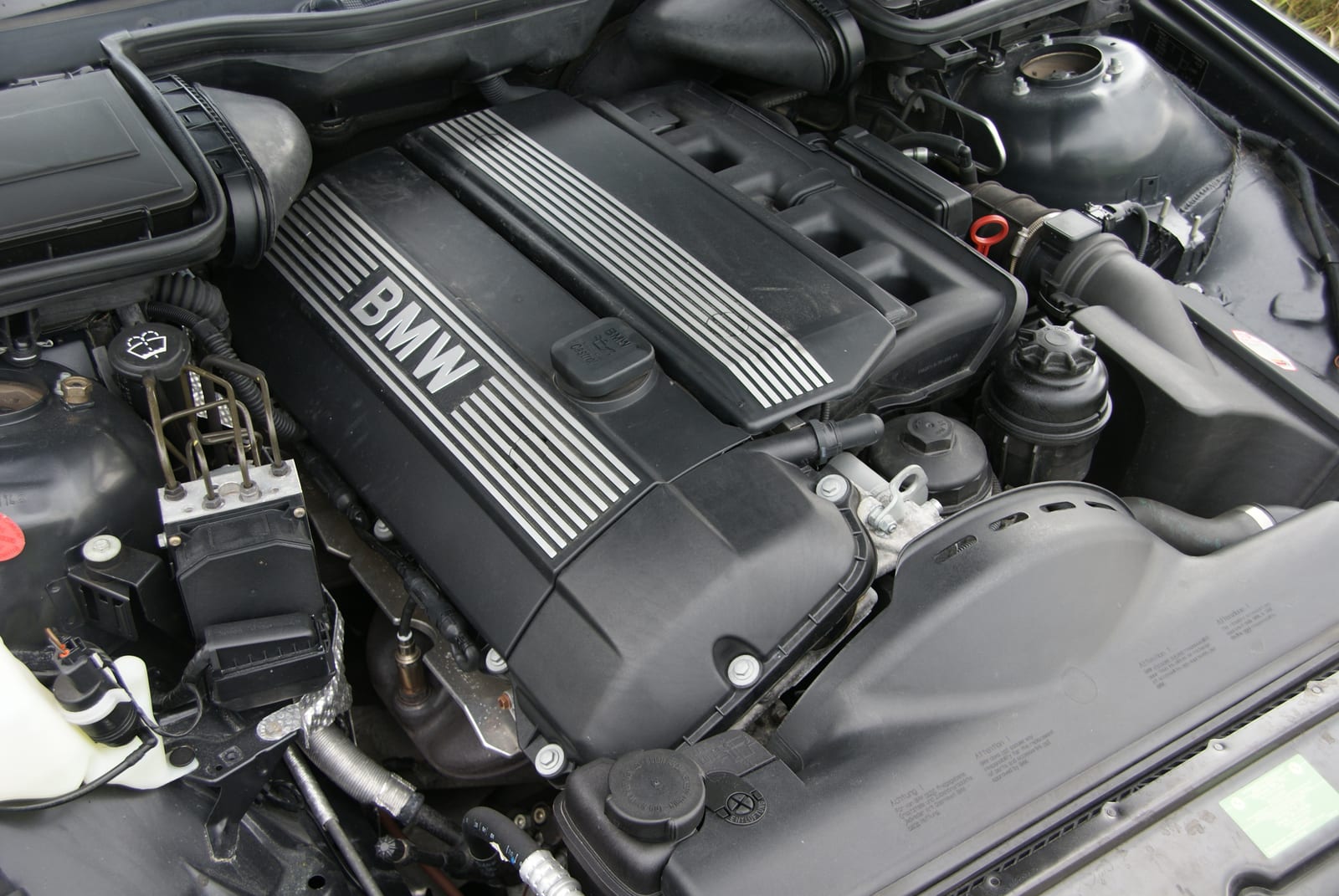
A noise from the engine bay, low-rpm hesitation, or a rough idle with lean codes can point toward the BMW M54 DISA valve. None proves the valve is defective. The right first move is to tell a loose flap, failed actuator or unrelated intake leak apart before ordering parts.
Scope: BMW M54B25 and M54B30 in representative North American E46 325i/330i, E39 525i/530i, E53 X5 3.0i, and M54-equipped E83 X3, Z3 and E85 Z4 applications. Confirm VIN, engine, market, production date and installed part. Other engines, such as the M52TU and S54, are outside this article. For engine identification, see M52 vs. M52TU vs. M54.
What the DISA does
BMW's M54 resonance intake uses a vacuum-actuated flap to change the effective intake path. With the flap closed, intake pressure waves help low-to-midrange torque. When the flap opens, both resonance paths support higher-rpm breathing. BMW's MS43 training document, written for the 2001 X5 M54B30, describes the solenoid energized below approximately 3,750 rpm and de-energized above approximately 4,100 rpm; the latter transition varies with temperature. These are the documented thresholds for that training application, not universal calibration values for every later M54. BMW M54 training, pp. 42 and 43.
Symptoms and competing explanations
| Observation | DISA possibility | Also investigate |
|---|---|---|
| Loud noise from the engine bay | Loose flap, worn linkage or pivot pin | Other engine-bay noises |
| Low-rpm hesitation or sluggishness | Flap not moving as commanded | Ignition, fuel, VANOS and intake leaks |
| Rough idle or lean faults | Failed DISA (ECS lists both as symptoms) | Intake boots, CCV and other vacuum leaks |
These are clues, not confirmation. ECS M54 symptom guide.
How to diagnose an M54 DISA
1. Identify the engine and save diagnostic information
Confirm the VIN and whether the engine is M54B25 or M54B30. Save fault codes and freeze-frame data before clearing them. Note whether the problem occurs at idle, on a cold start or during acceleration. A lean code does not identify the leak's location.
2. Inspect for air leaks
Check accessible intake boots, connections and the DISA-to-manifold sealing area. A smoke test can help locate leaks. Other causes of similar symptoms, including the crankcase ventilation system, are covered in our M54 CCV guide.
3. Remove the DISA carefully
BMW's E46 M54 TIS instruction begins with the ignition off. On E46, disconnect the intake hose between the air-mass flow sensor and the connecting piece, unlock and detach the DISA plug, release the screws and withdraw the unit. Other chassis have different access. BMW TIS repair instruction 11 61 095. Check that the steel pivot pin is still in the valve. G.A.S. pin inspection.
4. Inspect flap, linkage, housing and vacuum actuator
Look for a flap that is loose or disconnected, a displaced pivot pin, cracks around the bearing support and worn linkage. German Auto Solutions describes a vacuum-pot test: close the flap by hand, cover the hole it shows with your thumb, then release the flap. On a good unit the flap springs open part way and stops; on a bad one it springs fully open. Use its photos to find the correct hole. A failed test is a component clue, not proof that every drivability complaint is caused by DISA. G.A.S. instructions, pp. 3 and 4.
2.5-liter vs. 3.0-liter DISA: part numbers
Do not order from the model badge alone. These are representative M54 replacement numbers confirmed by the individual retailer fitment listings, not universal parts for every BMW wearing a 325 or 330 badge. Verify the VIN and current supersession before buying. M54B25 listing; M54B30 listing.
| Engine | BMW reference | Representative applications |
|---|---|---|
| M54B25 2.5 L | 11617544806 | E46 325i/325Ci/325xi, E39 525i, M54 Z3 2.5i, Z4 2.5i, X3 2.5i |
| M54B30 3.0 L | 11617544805 | E46 330i/330Ci/330xi, E39 530i, X5 3.0i, M54 Z3 3.0i, Z4 3.0i, X3 3.0i |
Engine code and VIN take precedence over the model badge. German Auto Solutions reports finding 2.5-liter DISA valves installed on 3.0-liter engines by previous owners, so do not assume the installed valve is the right one.
Repair or replace?
A rebuild kit can make sense when the housing, bearing support and vacuum actuator are sound and the kit matches the exact flap size. German Auto Solutions warns it has found 2.5-liter DISA units installed on 3.0-liter engines and instructs installers to compare flap dimensions before rebuilding. G.A.S. repair instructions, p. 1.
Replace the assembly when the housing is cracked, the vacuum actuator is faulty or the existing valve cannot be safely rebuilt. German Auto Solutions treats cracked or broken plastic, or a failed vacuum pot, as a sign the valve may not be repairable (pp. 3 and 7). If the pin is missing, find it before starting the engine, whether or not a new unit goes in.
After confirming the installed engine and part number, two specific aftermarket replacements with displacement fitment are Rein M54B25 DISA 11617544806 and Rein M54B30 DISA 11617544805. Verify fitment using the seller's vehicle selector and VIN. Direct listings: 2.5 L and 3.0 L.
Affiliate disclosure: Some parts links are affiliate links. Department 69 may earn a commission at no extra cost to you.
Reinstalling the DISA
ECS's procedure: wipe the gasket surface inside the manifold with a clean, lint-free towel, rotate the flap closed and hold it closed as you slide the valve in, then press in firmly until it is fully seated. Install the two mounting bolts, reconnect the electrical plug until it clicks, then refit the breather hose, air box tube, air box lid and intake boot and reconnect the air-mass flow sensor plug. ECS illustrated installation guide.
Mounting bolt torque: ECS's M54 DISA installation procedure specifies 10 Nm (7 ft-lb) for the two mounting bolts (T40 Torx). The BMW TIS removal page does not state a torque. Treat this as an aftermarket-published value, confirm it against factory information for your VIN, and do not apply it to other manifold hardware. ECS torque instruction.
Frequently asked questions
Can a DISA cause lean codes?
ECS lists a rough idle with lean codes among the symptoms of a failed M54 DISA. Lean codes have many possible causes, so inspect the rest of the intake and the CCV system too. ECS M54 guide.
Does unplugging the DISA prove it is bad?
No. In BMW's training description, the ECM switches a solenoid that supplies vacuum to close the flap, so unplugging it only changes how the flap is commanded. It does not show whether the flap, actuator and seal are healthy. BMW training, p. 42.
Is a noisy DISA dangerous?
It can be. ECS warns that the pin holding the flap can slip out and be pulled into the engine, and German Auto Solutions reports pins that fell out and ruined engines. If the pin is missing, do not start the engine until it is found. ECS; G.A.S. instructions, p. 7.
Do M54 325i and 330i use the same DISA?
Normally not: M54B25 uses reference 11617544806 and M54B30 uses 11617544805 in the checked listings. Verify engine code, VIN and exceptions. 2.5 listing; 3.0 listing.
Sources
- BMW M54 engine training, resonance system pp. 42 and 43.
- BMW TIS E46 325i M54 DISA removal instruction (11 61 095).
- ECS M54 DISA installation and torque procedure.
- German Auto Solutions DISA inspection and repair guide.
- Turner M54B25 DISA fitment and Turner M54B30 DISA fitment.
Technical disclaimer: This independent reference is not a substitute for current factory repair information for the exact VIN. Engine, software, market and production-date variations affect fitment and procedures. Work safely around hot and moving components. Stop if any hardware is missing from the intake. No first-hand test of the reader's vehicle is claimed.