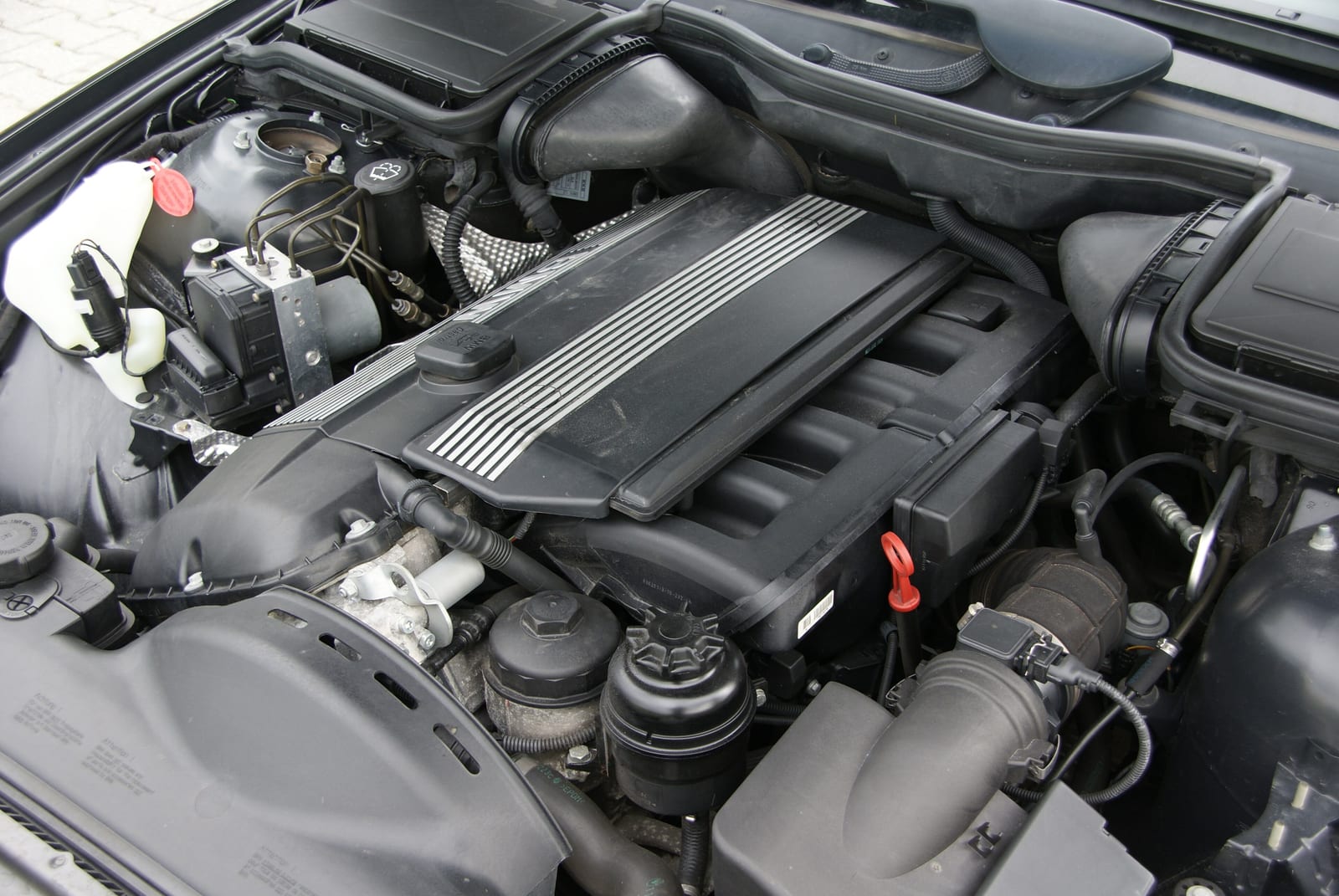
BMW M54 crankcase ventilation problems can look like several unrelated engine faults: a whistling noise, unstable idle, oil consumption, oil in the intake, or even a damaged valve cover. The oil separator is a plausible suspect, but none of those symptoms proves it has failed. BMW's own service bulletin lists these as possible results of incorrect crankcase pressure and gives a measurement procedure to check it. [1]
This guide covers the BMW M54 naturally aspirated inline-six, including applications such as the E46 325i/330i, E39 525i/530i, E53 X5 3.0i, E83 X3 2.5i/3.0i and E85 Z4 2.5i/3.0i. Fitment and production dates vary; confirm the engine and parts using the vehicle VIN. It does not treat the M52, M52TU or S54 as interchangeable with the M54 (see how to tell the M52, M52TU and M54 apart).
What the M54 oil separator actually does
BMW describes a pressure-controlled crankcase ventilation system whose valve uses a spring and diaphragm to control crankcase pressure. A properly working valve is designed to maintain a slight vacuum in the crankcase so it vents reliably in all operating conditions. Its service literature calls this system crankcase ventilation; owners often call the assembly the CCV, PCV, or oil separator. [1]
For a concrete parts example, an online BMW parts catalog for a U.S.-market April 2004 E46 325i Touring with M54 lists a pressure-regulating valve, vent pipe, connecting line, vent hose and return pipe. The catalog also distinguishes standard and cold-climate versions. That example demonstrates why replacing just one visibly damaged hose without inspecting the other connections may miss part of the problem. [2]
Symptoms: what they suggest, and what they do not prove
| Observation | Possible CCV connection | Important alternative |
|---|---|---|
| Whistling or howling | BMW lists unusual engine noise among the possible results of excessive vacuum. | Intake air leaks and other mechanical noises can sound similar. |
| Rough idle or misfires | BMW lists rough running and misfires in its ventilation diagnostic bulletin. | Ignition, fueling, and intake leaks also require investigation. |
| Unexplained oil consumption | BMW associates both excessive crankcase pressure and vacuum with increased oil use. | External leaks and internal engine wear are other possibilities. |
| Oil in the intake | Excessive oil carryover is among BMW's documented ventilation symptoms. | Some oil residue alone does not establish a failed separator. |
| Oil leaks or seal problems | BMW lists damage to engine oil seals as a result of both excessive pressure and excessive vacuum. | Aging gaskets may leak independently. |
| High mixture adaptation (fuel trim) values | BMW lists increased mixture adaptation values among the results of excessive vacuum. | Intake leaks raise adaptations too; adaptations alone do not identify the CCV. |
All six associations come from BMW Service Information Bulletin SI B11 03 08. They are possible results of a ventilation fault, not proof of one. [1]
Why the oil-cap test is not a verdict
Owners sometimes loosen the oil filler cap at idle and judge the amount of suction by feel. That may suggest something worth investigating, but it is not a calibrated pressure measurement. BMW's bulletin gives a measurement procedure using its ISID and IMIB diagnostic equipment. A cap that is difficult to remove, a change in idle, or a brief hiss should not by itself be used to order a complete CCV system. [1]
BMW's published crankcase pressure specification
In its October 2013 bulletin, BMW lists the M54 together with the M52 and M52TU at a crankcase pressure specification of 16 mbar (about 0.23 psi, or 6.4 inches of water), with the system designed to hold a slight vacuum. BMW says actual readings may vary from specification by up to 10 percent but not more than 5.0 mbar, that its figures were recorded with the IMIB, and that other measuring tools may give results outside specification. Do not compare an uncalibrated hand test or a generic vacuum gauge reading to this figure as if the methods were identical. [1, p. 2]
A practical diagnostic sequence
- Verify the engine. Confirm the VIN, production month and M54 application before looking up diagrams or ordering a kit.
- Record the symptoms. Note whether noise, rough idle or oil use occurs only when cold, at idle, or after a long drive. Record any diagnostic trouble codes without assuming their cause.
- Inspect accessible ventilation plumbing. Look for disconnected, split or oil-soaked connections. Use the VIN-specific parts diagram to locate the pressure-regulating valve and associated lines. [2]
- Check other intake leak points. An intake leak can mimic CCV symptoms. A professional smoke test can help locate leaks; use a method suitable for the vehicle and avoid pressurizing the crankcase indiscriminately.
- Measure crankcase pressure. Compare a properly obtained reading with BMW's published diagnostic guidance rather than the oil-cap feel test. [1]
- Inspect the oil-return path if indicated. Especially on cold-climate cars, a restriction in the separator, hose or dipstick-guide-tube orifice matters. BMW specifically identifies those locations in its freezing bulletin. [3]
The cold-weather failure that deserves special attention
BMW issued SI B11 08 03, Oil Separator - Cold Climate Conditions, covering all M54-equipped E39, E46, E53, E60, E83 and E85 models. It says a small number of cars in extremely cold U.S. climates had problems ranging from leaking or broken valve covers to complete engine failure, and describes moisture freezing in the oil separator, its hose to the dipstick guide tube, or the guide-tube orifice. Depending on the position of the internal valve, the result can be high crankcase pressure with valve cover leakage or breakage (stuck closed), or an oil hydro-lock condition that could damage the engine (stuck open). BMW's correction is to replace the crankcase vent valve and hoses with the insulated style and replace the dipstick guide tube. [3]
Safety note: If a cold-soaked engine suddenly refuses to turn normally, has severe new mechanical noise, or shows signs of liquid ingestion, do not repeatedly crank it. Arrange proper diagnosis to avoid compounding possible damage.
Parts selection: standard versus cold-climate components
The April 2004 U.S. E46 325i Touring catalog example lists pressure-regulating valve 11 61 7 501 566 and a separate cold-climate/Canada application valve 11 61 7 533 400. It also lists different versions of certain connecting pipes and hoses. These numbers are illustrative of that exact catalog example, not a universal M54 shopping list. Production date, market, equipment and supersessions can change applicability; check the VIN against a current catalog before purchase. [2]
When the system is already being opened, consider the condition of every brittle plastic connection and the return path, not only the valve. A kit is convenient only if every included part is correct for the specific car. No product affiliate links are included here because a current retailer listing was not independently matched to all relevant fitment variations.
Common questions
Does a hard-to-remove oil cap mean the M54 CCV is bad?
No. Excessive crankcase vacuum is consistent with a regulating-valve problem, but the oil-cap feel test does not measure vacuum. BMW provides a pressure-measurement specification and procedure. [1]
Can a bad CCV cause oil consumption?
Yes, BMW lists increased oil consumption among the results of both excessive crankcase pressure and excessive vacuum. That does not exclude worn seals or internal engine problems. [1]
Is a cold-climate CCV kit necessary everywhere?
Not automatically. BMW documented a particular freezing failure in very cold conditions, and its parts catalog distinguishes equipment variants. Choose parts based on the VIN, climate exposure, and applicable service guidance, not a universal claim that one kit fits all M54 cars. [3]
Does this procedure apply to the M52TU or S54?
No. Although BMW's pressure bulletin groups M52TU and M54 in one specification row, their installation details and parts should not be assumed identical. The S54 is a different engine and has its own published pressure figure. Use engine-specific repair information. [1]
Sources and further reading
- BMW of North America, SI B11 03 08 (October 2013), Crankcase Ventilation System Diagnosis and Measurement, NHTSA-hosted PDF.
- bmwfans.info parts catalog, E46 325i Touring (USA), M54, April 2004, crankcase ventilation/oil separator; independent catalog, verify against VIN.
- BMW of North America, SI B11 08 03 (March 2009 revision), Oil Separator - Cold Climate Conditions, PDF copy of the BMW bulletin.
Technical disclaimer: This is an educational diagnostic reference, not a substitute for the VIN-specific BMW repair procedure, proper equipment, or professional assessment. Stop work if there are signs of possible engine hydro-lock, serious mechanical damage, or unsafe operating conditions. Confirm specifications and parts against current factory information before repair.