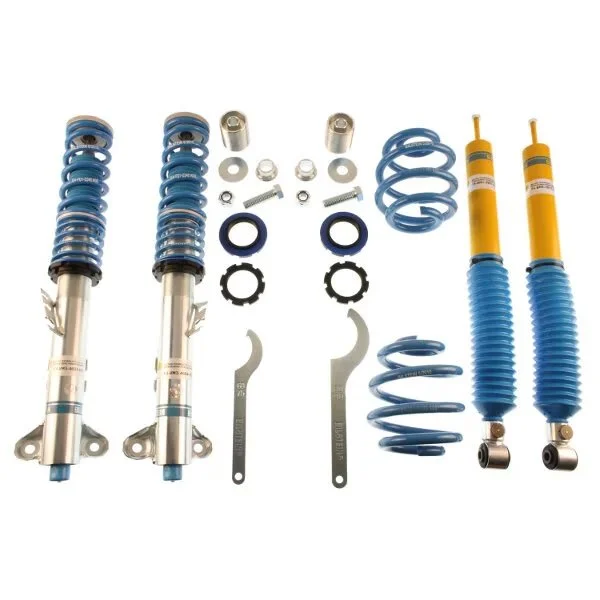
The BMW E36 has one of the most active suspension communities in the enthusiast world. Whether you drive a 318i daily or a slammed M3 on track days, the coilover conversation comes up constantly on R3VLimited and BimmerFest. After reading hundreds of threads, the pattern is clear: a few brands dominate, and the rest get warned against.
Here's what E36 owners actually run, sorted by use case.
Quick Comparison
Option                  Price Range    Best For                  Damping Adj.       Warranty
──────────────────────  ─────────────  ────────────────────────  ─────────────────  ─────────────
Solo-Werks S1           ~$450–550      Budget daily / mild drop  Height only        1 year
BC Racing BR Series     ~$850–950      Street + light track      30-way single      1 year
H&R Street Performance  ~$1,200–1,500  Comfort-focused street    Height only        Ltd. lifetime
KW Variant 3            ~$2,500–3,000  Street/track dual-use     2-way independent  Lifetime
Before You Buy: Do You Actually Need Coilovers?
Coilovers solve a suspension problem — but not every suspension problem needs coilovers. Before spending $500–3,000, check these first:
Check your bushings. If your control arm bushings, subframe bushings, or strut mounts are cracked or collapsed, new coilovers will feel terrible no matter how much you spend. Worn bushings are responsible for a huge percentage of "my coilovers feel harsh/clunky" complaints on the forums. A set of polyurethane control arm bushings runs $80–150 and should be done before or alongside any suspension work.
Check your wheel bearings. A failing wheel bearing produces a low rumble that changes with cornering load, often mistaken for suspension noise. Pull each wheel and check for play before assuming the shocks are gone.
Is it actually the shocks? Worn struts bounce excessively, nose-dive hard under braking, and produce a clunking sound over bumps. If your car currently handles well and you just want lower/better — that's a coilover upgrade, and a valid one. If something sounds or feels broken — diagnose it first.
First: Springs vs. Coilovers
Before picking a coilover, know the difference. Springs drop your car on the stock shocks — cheaper, but the shocks are now working outside their design range and will wear faster. Coilovers replace both the spring and the shock as a single unit, giving you proper damping at your chosen ride height.
For any serious street or track setup, coilovers are the right answer. The price gap has closed significantly in the past decade, and the ride quality difference is substantial.
What Matters When Choosing Coilovers
Spring rate determines how stiff the ride is. Too soft and the car wallows; too stiff and you're skipping over bumps. For street use, rates around 6–8 kg/mm front, 5–7 kg/mm rear work well. For track, 10+ kg/mm is common.
Damping adjustment controls how quickly the shock absorbs and releases energy. Single-way adjustment (just rebound) is sufficient for street cars. Two-way (compression + rebound) is for serious track use and requires more tuning knowledge to set up well.
Ride height adjustment is what makes a coilover a coilover. Most quality units give you 2–4 inches of adjustment. Lower isn't always better — going too low without proper alignment causes tire wear and handling issues.
The Options: What E36 Forums Actually Run
🥇 KW Variant 3 — The Premium Street/Track Choice
Best for: owners who want a forever coilover they never have to think about again
KW's Variant 3 is the most-recommended coilover for E36 owners who want genuine adjustability without going full race suspension. Two-way independent damping adjustment (compression and rebound separately), stainless steel construction, and a lifetime warranty put it in a different category from most of the competition. R3VLimited threads consistently describe it as "the last coilover you'll buy."
It's tested at the Nürburgring and works equally well on canyon roads and track days. The spring rates are well-matched to the E36 chassis. The only criticism is the price — but owners report zero regrets.
Kit cost: ~$2,500–3,000 | Best for: street/track dual-use, serious drivers
💡 Price note: ECS Tuning is our go-to for in-stock reliability, but KW V3 sets have a healthy used market. A set with 20k–30k miles from a club racer who upgraded is a legitimate buy — check the R3VLimited classifieds and BimmerPost Marketplace. Inspect threads for corrosion, compress each damper by hand to confirm smooth travel, and verify the spring perches aren't cracked.
👉 KW Variant 3 Coilovers for BMW E36 on ECS Tuning
🥈 BC Racing BR Series — The Sweet Spot
Best for: enthusiasts who want adjustability without the KW price tag
BC Racing's BR Series is the most-recommended coilover in the $800–1,000 range, full stop. 30-way damping adjustment, linear spring rates, 2–5 inches of ride height range, and a solid warranty. The damping quality doesn't match KW, but it's dramatically better than budget alternatives and has real adjustability that lets you tune the car to your preference.
Forum reports on BimmerFest and Driftworks consistently praise the BR Series for street daily drivers and light track use. It's the "buy it and stop worrying" option if you're not ready to spend KW money.
Kit cost: ~$850–950 | Best for: street daily drivers, entry-level track, budget builds
💡 Price note: Compare ECS Tuning against Turner Motorsport and direct BC Racing distributors before ordering — prices on this model move around and you can often save $50–100 by shopping around.
👉 BC Racing BR Series Coilovers for BMW E36 on ECS Tuning
Solo-Werks S1 — Best Under $600
Best for: first coilover buyers on a strict budget
If you need to get off stock suspension and can't stretch to BC Racing, Solo-Werks S1 is what the forums recommend. ModBargains and R3VLimited describe it as "the best quality inexpensive coilover on the market" — monotube design, proper ride height adjustment, and respectable build quality for the price. Not what you'd run at a track day, but a significant upgrade over stock with appropriate expectations.
Kit cost: ~$450–550 | Best for: daily drivers, mild drops, budget builds
"I must say, I've had these Solo-Werks for a little over a year now, and I absolutely love them. I have them on my 325 vert which is slammed and I drive the absolute sh*t out of that car, and they have withstood everything I've thrown at them. The spring rate is near perfect in my opinion, gives great feedback on bumps when cornering hard, and is butter smooth on the highway. Overall best $500 I've spent and would highly recommend."
— adamls2, Bimmerforums — E36 Solo Werks S1 Review
👉 Solo-Werks S1 Coilovers for BMW E36 on ECS Tuning
H&R Street Performance — The Mid-Range Option
Best for: drivers who want improved handling with a comfortable street ride
H&R's Street Performance kit slots between budget and premium. Known for better ride quality than BC Racing at similar price points, the H&R is a good choice if you're daily-driving in a city where you care more about comfort than adjustability. Less adjustment range than BC Racing, but the spring rates are well-calibrated for street use.
Kit cost: ~$1,200–1,500 | Best for: comfort-focused street driving, daily commuters
👉 H&R Coilovers for BMW E36 on ECS Tuning
What to Avoid
D2 Racing and HSD coilovers come up regularly as things to steer clear of. Forum threads across R3VLimited and BimmerPost report inconsistent damping between corners, premature seal failures, and poor customer support. The low price looks appealing but the reliability track record doesn't hold up over time.
Unknown Chinese brands sold on Amazon should be avoided entirely. The spring rates and damping specs are often incorrect, and the hardware quality can compromise safety.
What to Inspect While You're In There
Since the front and rear suspension is already disassembled, this is the time to check everything adjacent. Skipping this is how you end up pulling the suspension again six months later.
Control arm bushings: Squeeze and flex each one. Cracks, tears, or excessive softness mean replacement. Polyurethane bushings (Turner, Condor Speed Shop) are the upgrade path; OEM rubber is quieter if daily driving comfort is the priority.
Wheel bearings: Spin each hub by hand. Roughness, grinding, or play in any direction means the bearing is due. Wheel bearings on E36s with track miles wear faster than stock — address them now if there's any doubt.
Brake lines: On a high-mileage E36, the rubber sections of the brake lines develop internal cracks that cause sponginess and pedal fade. If they're original, this is a good time to swap stainless braided lines — it's a cheap upgrade that improves pedal feel noticeably.
Strut mounts (top hats): The upper strut bearing can wear and create a clunking sound through corners. Replace them if there's any play — the Lemforder OEM unit is the standard recommendation.
Common Installation Mistakes
Torquing strut nuts with the car in the air. This is the single most common coilover installation mistake. All suspension fasteners — lower mount bolts, control arm bolts — must be torqued with the suspension at ride height and the car's weight on the wheels. Torquing in the air preloads the bushings in a compressed position; when the weight comes back on, they're twisted and will wear prematurely. Put the car on the ground, bounce it to settle the suspension, then torque.
Setting ride height before alignment. Set your initial ride height, then drive it to alignment. Don't spend time dialing in exact height at home — the alignment shop will adjust ride height during the process, and final numbers often differ from your driveway measurement.
Forgetting the alignment. Not optional. Every coilover installation requires a four-wheel alignment. Running misaligned corners causes uneven tire wear and handling imbalance. Budget $150–250 at a shop that knows BMW geometry.
Going too low without checking clearances. On the E36, aggressive drops can cause the front fenders to contact 235-width tires under compression. Check clearance with the wheel turned full lock before finalizing ride height.
After Installation: What to Watch For
Squeaking over bumps: Usually the spring perch contact surface needs lubrication. Remove the coilover, clean the top and bottom spring perch mating surfaces, and apply a thin layer of grease or anti-squeak spray. This is extremely common and easy to fix.
Clunking or popping: Most likely a loose strut nut (top mount), a control arm bolt that wasn't torqued at ride height, or a worn end link. Work through each systematically — they all have different sound characters.
Ride feels too stiff or too soft: If the coilovers have damping adjustment, start in the middle of the range and work from there. Give yourself 500 miles before making final calls — springs settle and the car needs to break in.
Car pulling to one side: Alignment issue. Get back to the shop.
Bottom Line by Budget
Under $600: Solo-Werks S1 — get off stock, real adjustability, no track use.
$800–1,000: BC Racing BR Series — the community standard, daily drivable with track potential.
$1,200–1,500: H&R Street Performance — if comfort matters more than track ability.
$2,500+: KW Variant 3 — if you want to stop thinking about coilovers forever.
Frequently Asked Questions
What coilovers does R3VLimited recommend for a daily-driven BMW E36?
For a street-driven E36, R3VLimited consistently recommends BC Racing BR Series as the best value, or KW Variant 3 for those who want a forever coilover. Solo-Werks S1 is the top recommendation under $600. Budget brands like D2 and HSD are repeatedly warned against.
Do I need an alignment after installing coilovers on my E36?
Yes, always. Every coilover installation changes ride height and therefore camber, caster, and toe. Skipping alignment causes rapid, uneven tire wear and unpredictable handling. Budget $150–250 at a shop familiar with BMW geometry.
How low can I go on E36 coilovers without rubbing?
On the E36 with 225-width tires, 2–2.5 inches of drop is typically safe with proper alignment. 235-width tires on aggressive drops can contact the front fenders under full lock. Always check clearance with the wheel turned to full lock before finalizing your height setting.
What's the difference between single-way and two-way damping adjustment?
Single-way adjustment controls rebound only (how fast the shock extends after compression). Two-way adjustment controls compression and rebound independently, giving much more precise tuning. For street use, single-way is sufficient. Two-way is for track cars where you're actively tuning for specific corners.
Can I install E36 coilovers myself, or do I need a shop?
E36 coilover installation is a solid DIY job for anyone comfortable with suspension work. The critical step most DIYers miss: torque all lower mount and control arm bolts with the car at ride height and weight on the wheels, not in the air. An alignment cannot be skipped regardless of who does the install.
More Guides on Department 69