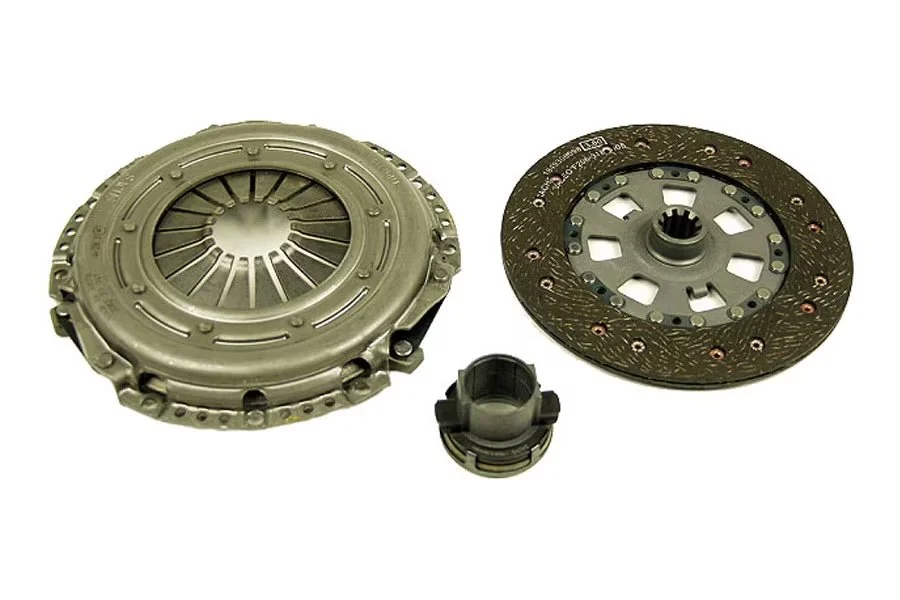
The BMW E36 clutch conversation is one of the clearest examples of enthusiasts over-engineering a solution. There's a strong pull toward "stage 2" and "stage 3" clutch kits whenever the topic comes up — but most E36 owners don't need them, and installing one without the right supporting work can actually make the car worse to drive.
Here's what the R3VLimited and BimmerPost communities actually run, and more importantly, why.
Quick Comparison
Kit                        Price Range  Best For                                 Street Feel     Pedal Effort
─────────────────────────  ───────────  ───────────────────────────────────────  ──────────────  ──────────────────
Sachs OEM-Spec             ~$350–500    Stock to mildly modified, daily drivers  Stock — smooth  Stock
Sachs Performance          ~$600–800    E36 M3, 10–30% power mods, track street  Near-stock      Slightly heavier
South Bend Stage 3 / Spec  ~$800–1,200  High-power or track-only builds          Firm / grabby   Noticeably heavier
When Does the Clutch Need Replacing?
Before buying anything, confirm the clutch is actually the problem. These symptoms point to a worn clutch: slipping under hard acceleration where the revs climb without a matching speed increase; difficulty engaging gears smoothly, especially when cold; chatter or vibration on takeoff; a burning smell under spirited driving; or a pedal that engages higher than usual or feels spongy.
Check the hydraulics first. A lot of "clutch slipping" diagnoses are actually a failing clutch master or slave cylinder. If the pedal feels soft or requires pumping to get a firm engagement, bleed the clutch hydraulics before assuming the disc is worn. A hydraulic problem costs $80–150 to fix; a clutch job is $600+ in labor alone. Rule it out.
Most E36 clutches last 80,000–120,000 miles under normal use. If you're approaching these mileages and haven't done a clutch, consider doing it during any job that requires transmission removal anyway — the marginal cost of a clutch kit when the transmission is already out is minimal compared to pulling it again later.
First: Match the Clutch to Your Actual Build
The single most common mistake in E36 clutch replacement is over-specifying. A stage 3 clutch on a stock or mildly modified street car has harsh engagement, causes transmission wear from the increased clamping force, and requires constant attention on the pedal in traffic. It's not more reliable — it's just harder to drive.
The forum rule of thumb from R3VLimited: if you can't describe in one sentence what modification requires more clutch capacity than OEM, you don't need a performance clutch.
The Options: What the Community Actually Installs
🥇 Sachs OEM-Spec Clutch Kit — For 90% of E36 Owners
Best for: stock engines, mildly modified cars, daily drivers
Sachs is BMW's OEM clutch supplier. When BMW installs a clutch at the factory, it's a Sachs. When you buy a "Genuine BMW" clutch from the dealership, you're getting a Sachs-manufactured component. Buying the Sachs kit directly skips the BMW markup and gets you the same part.
The OEM spec clutch handles aggressive street driving comfortably, including track days on a naturally aspirated E36 without major power modifications. The community consensus on BimmerFest and BimmerPost is consistent: OEM clutch replacement is the right answer for the vast majority of E36 owners. It engages predictably, wears at a known rate, and doesn't require any special pedal technique.
Cost: ~$350–500 (clutch + pressure plate + release bearing) | Best for: stock to lightly modified, any daily driver
Forum Verdict — R3VLimited & Bimmerforums
Thread after thread on R3VLimited and Bimmerforums lands on the same conclusion for stock and lightly modified E36s: Sachs OEM is the correct answer. Do the complete kit — disc, pressure plate, and release bearing — while the transmission is already out, and don't overthink it.
💡 Price note: ECS Tuning is a reliable source for Sachs kits. Also check FCP Euro — they offer a lifetime replacement guarantee on OEM-spec parts, which means if the clutch fails prematurely you get a replacement at no cost. Compare pricing between the two before ordering.
👉 Sachs Clutch Kit for BMW E36 on ECS Tuning
Sachs Performance Clutch — For E36 M3 and Modified Cars
Best for: E36 M3, supercharged/turbocharged builds, track-dedicated cars
Sachs also makes a performance clutch line with higher torque capacity, better thermal resistance, and improved material friction characteristics. It still uses an organic friction compound (unlike the metallic discs in Stage 3+ kits), so the engagement feel remains close to stock — but with meaningfully more clamping force and heat tolerance.
This is what the E36 M3 community recommends for anything beyond a stock rebuild. R3VLimited threads on M3 clutches consistently recommend the Sachs Performance as the sensible upgrade — "near-stock levels of effort and engagement but much higher torque capacity" is how one user described it. For boosted E36s making significantly more torque than stock, this is the entry point.
Cost: ~$600–800 | Best for: E36 M3, 10–30% power modifications, track-focused street cars
South Bend Stage 3 / Spec Clutch — For Track and High-Power Builds
Best for: dedicated track cars, high-power builds only
Stage 3 clutches use a puck-style or ceramic friction disc with significantly higher torque capacity. They're appropriate for high-power or track-only applications but come with real compromises: harsher engagement, drivetrain chatter at idle, and reduced daily drivability.
The honest forum consensus on R3VLimited: owners who installed Stage 3 clutches on their daily-driven E36s frequently report regretting it. The clamping force and engagement characteristics that make sense on a track car become annoying in stop-and-go traffic. One frequently-cited post: "couldn't wait to put the stock clutch back in."
Only go here if you've genuinely exceeded the Sachs Performance's torque capacity, or if the car is a dedicated track build that doesn't see daily street use.
Cost: ~$800–1,200 | Best for: track-only, big power builds
The Flywheel Question
Every clutch job raises the flywheel question. Lightweight flywheels (aluminum or lightened steel) improve throttle response and rev speed, but come with tradeoffs: more idle chatter, harsher engagement, and some transmission wear over time. For a daily-driven street car, the OEM dual-mass flywheel replacement is the correct answer. For a track car or a build where revs matter more than comfort, a lightweight flywheel makes sense — but only when paired with the rest of the drivetrain bushing work.
Critical warning: Multiple R3VLimited threads emphasize this — do not install a high-bite performance clutch without first replacing all drivetrain and transmission bushings. A worn bushing setup with an aggressive clutch produces harsh vibrations, transmission noise, and accelerated wear. The bushings are the prerequisite, not an optional add-on.
What to Inspect While You're In There
Clutch jobs require pulling the transmission, which gives you access to parts that are otherwise difficult or expensive to reach. Skipping these checks is how you end up removing the transmission again in 30,000 miles.
Rear main seal: The rear main seal sits right at the clutch housing and is trivially cheap ($15–25) with the transmission already out. A leaking rear main seal ruins the new clutch disc — clutch material and oil don't mix. Inspect it and replace it now regardless of condition. This is the most commonly skipped item on E36 clutch jobs.
Input shaft bearing (pilot bearing): The pilot bearing centers the transmission input shaft in the flywheel. It's a $10 part with the transmission out. If it's worn, you'll hear a grinding noise when the clutch is depressed. Replace it every time.
Drivetrain and transmission mount bushings: With the transmission accessible, inspect all transmission and differential mounts. Cracked or collapsed mounts cause the drivetrain to shift under hard acceleration and worsen clutch engagement feel. On an E36 with 80,000+ miles, these are likely overdue.
Flywheel condition: Inspect the flywheel face for heat cracks, scoring, and hotspots (blue discoloration). Measure runout with a dial indicator if possible. A warped or cracked flywheel will cause chatter with any clutch disc. Resurfacing runs $50–80 at a machine shop and is often worth doing rather than running a new disc on a damaged surface.
Common Installation Mistakes
Not using a clutch alignment tool. The clutch disc must be perfectly centered on the flywheel before the pressure plate bolts are torqued. Without an alignment tool, the transmission input shaft won't pass through the disc during reinstallation — or worse, it will go in with difficulty and leave the disc slightly off-center, causing vibration and premature wear. The tool costs $10 and is not optional.
Skipping flywheel resurfacing on a scored flywheel. A grooved or glazed flywheel causes the new friction disc to engage unevenly, producing shudder and chatter that won't improve over time. If the flywheel face shows any visible scoring, send it to a machine shop. The cost of a resurface is far less than another clutch job.
Not replacing the rear main seal. As noted above — if there's any seepage from the rear main, the new clutch will be oil-contaminated. The seal is cheap and the labor is already there. There is no reasonable argument for not replacing it.
Torquing pressure plate bolts unevenly. Pressure plate bolts must be torqued in a star pattern, gradually increasing torque across multiple passes. Tightening them sequentially warps the pressure plate and causes vibration. Use a torque wrench and follow the pattern in the service manual.
After the Job: What to Watch For
Clutch chatter or shudder on engagement: Usually either a glazed flywheel that wasn't addressed, a contaminated disc (oil from a rear main seal leak), or a misaligned disc. If chatter appears immediately after install, it's most likely alignment or surface condition.
High or inconsistent engagement point: Almost always a hydraulic issue — air in the clutch hydraulic line. Bleed the clutch system completely. The E36 uses a self-adjusting hydraulic clutch, so there's no manual adjustment — bleeding is the fix.
Transmission difficult to shift smoothly: If shifting was smooth before the clutch job and is now notchy or stiff, the transmission input shaft is likely not fully seated or the clutch wasn't aligned correctly. The disc may be binding on the input shaft splines. Remove and reinstall with the alignment tool.
Noise when pressing the clutch pedal: A squeak or whine when pressing the pedal is usually the release bearing. If you didn't replace it during the clutch job, you'll be back in sooner than you'd like. This is why the full kit — disc, pressure plate, and release bearing — should always be done together.
Bottom Line
Stock or mildly modified E36: Sachs OEM-spec — same part BMW installed, correct for almost everyone.
E36 M3 or 10–30% power modification: Sachs Performance — better torque capacity, still street-friendly.
High-power or track-only: South Bend Stage 3 or Spec — with full awareness of the drivability tradeoffs.
Frequently Asked Questions
What clutch does R3VLimited recommend for a stock or mildly modified BMW E36?
Sachs OEM-spec is the consistent R3VLimited recommendation for stock and mildly modified E36s. Sachs is BMW's actual OEM clutch supplier — you're getting the same component as BMW installs at the factory. Stage 2 and 3 kits are repeatedly recommended against for daily-driven cars; the harsher engagement and transmission wear don't justify the added capacity for street use.
How long does an E36 clutch typically last?
Most E36 clutches last 80,000–120,000 miles under normal use. Aggressive track driving and repeated hard launches shorten this significantly. If you're approaching these mileages and have any trans-out job planned, the marginal cost of doing the clutch while it's already out is well worth it.
Do I need to replace the flywheel when doing an E36 clutch job?
Not always, but inspect it closely. A flywheel with visible scoring, heat cracks, blue discoloration, or runout beyond spec should be resurfaced ($50–80 at a machine shop) or replaced. Running a new friction disc on a damaged flywheel causes chatter immediately and wastes the cost of the new clutch.
What other parts should I replace while the E36 transmission is out?
At minimum: rear main seal ($15–25 — prevents the new clutch from being oil-contaminated), input shaft/pilot bearing ($10 — replace every time), and transmission/differential mounts if they show cracking or collapse. Inspect all drivetrain bushings while you have access — worn bushings with a new clutch causes harsh vibration.
How do I know if my BMW E36 clutch is slipping?
Classic clutch slip: engine revs rise faster than vehicle speed under hard acceleration, especially in higher gears. Also: burning smell under aggressive driving, difficulty engaging gears cleanly when cold, or a clutch pedal that engages at a different height than usual. Before assuming clutch wear, bleed the hydraulics — a soft or sinking pedal is often a failing master or slave cylinder, not a worn disc.
More Guides on Department 69