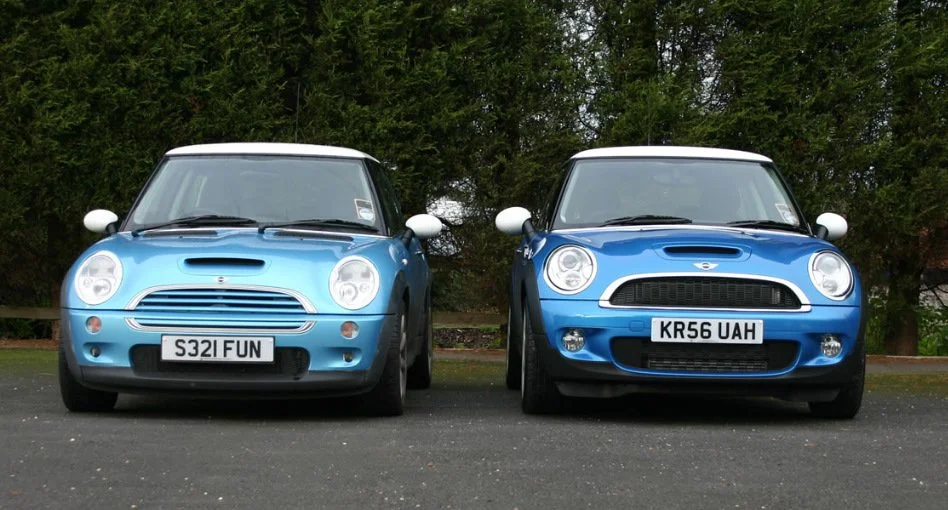
The R53 MINI Cooper S and its successor, the R56, represent a fork in the road. One arrived via supercharger; the other via turbo. One weighs 2,500 pounds; the other tips the scales at 2,800. One sounds like a mechanical project car; the other sounds like, well, a turbo four-cylinder. These aren’t minor differences in trim or generation cycle. They’re fundamentally different cars wearing the same badge.
This matters because buyers trying to decide between them aren’t just picking generations — they’re choosing between different philosophies. And the internet is full of half-answers. “The R56 is faster.” “The R53 is purer.” Both are true. Both are useless without context.
Let’s cut through it.
The Heart of the Matter: Supercharger vs Turbo
Before numbers or reliability, there’s what these cars feel like when you push on them. That feeling comes from how the engine makes power.
The R53 uses an Eaton M45 Roots-type supercharger, mechanically driven by a belt connected directly to the crankshaft. When the engine spins, the supercharger spins. Boost arrives immediately — there’s no threshold, no brief moment of wondering where the power went. Bury the throttle in an R53 and the car responds in real time. The power curve rises linearly from idle and keeps climbing to redline. At 3,000 rpm you feel it. At 5,000 you feel it more. Predictable and immediate.
The supercharger also generates a high-frequency mechanical whine that grows louder as rpm climbs. Some enthusiasts consider this one of the car’s greatest appeals. Others find it insufferable. There’s no middle ground, and the only way to know which camp you’re in is to drive one.
The R56 dropped the supercharger for a turbocharger. A turbo is driven by exhaust gases, not a belt. This creates turbo lag — a brief period where you’ve asked for power but the turbo hasn’t spooled yet. In the R56, this gap is compressed into the zone between 1,500 and 2,000 rpm, maybe 400–500 milliseconds in practice. Once the turbo lights up, boost arrives as a concentrated wave. More power than the R53, delivered differently — in a surge rather than a linear climb.
Which is more fun? The R53 is more intuitive. The R56 teaches you a different rhythm. Neither is objectively better. What matters is which rhythm suits you.
The Power and Performance Numbers
Stock R53 Cooper S: 163–170 horsepower, 155 lb-ft of torque at 4,500 rpm. With a JCW pulley kit and a proper tune, a stock R53 reaches 185–200 hp on its original internals. Past that, you’re asking factory components to hold power they weren’t designed for.
The R56 comes in two iterations. The N14 engine (2007–2010) makes 181 hp and 177 lb-ft in the Cooper S, 208 hp in the JCW. The N18 (2011–2013) improved bottom-end torque with similar peak numbers. Both have a higher tuning ceiling than the R53. A Stage 1 tune alone — ECU remap, minimal supporting mods — gets you to 220–240 hp reliably. Stage 2 with an intercooler, fuel pump, and injectors can push 250–270 hp on the N18 with room to spare.
If acceleration numbers are your metric, the R56 wins. The extra weight is offset by the extra power, and the ability to add more later without touching internals is a genuine advantage.
But numbers on a dyno tell you nothing about how a car feels underneath you. An R53 at 185 hp feels quick because everything about the car — weight, steering feel, engine response — is oriented toward quickness. An R56 at 181 hp feels heavier because it is. Until you’re tuned, the R53 feels faster even when the stopwatch says otherwise.
Reliability: The N14 Problem
This is where the decision can get expensive.
The R53 has one major achilles heel: the expansion tank. The plastic coolant expansion tank lives adjacent to the exhaust manifold and takes constant thermal cycling. Over time, the plastic becomes brittle and cracks. This will happen on any R53 that hasn’t had the tank replaced — usually somewhere between 80,000 and 150,000 miles. The fix is an aluminum replacement from Forge Motorsport or equivalent. Budget $300–$500. It’s mandatory maintenance, not optional.
Beyond that, the R53’s supercharger has an oil injection service interval (every 60,000–80,000 miles) that most previous owners skipped. Check the service history and budget accordingly if it’s unknown. A well-maintained R53 is a durable car.
The R56 brought different vulnerabilities. The big one is the N14 timing chain.
The N14’s chain tensioner relies on oil pressure and uses plastic chain guides. On cars with neglected oil changes — which describes a significant portion of used R56s on the market — the guides wear. The chain slackens. The symptom is a metallic rattle on cold start that disappears after a few seconds. The result of ignoring it is bent valves and a $4,000–$8,000 repair.
This is not a matter of if but when on high-mileage N14 cars with unknown maintenance history. An N14 with documented timing chain replacement is a completely different proposition from one where you’re guessing.
The 2011+ N18 engine revised the tensioner and improved the guide material. The failure rate is meaningfully lower. An N18 with clean records is a solid engine. A water pump replacement around 50,000–60,000 miles is the other major budget item on R56 — both N14 and N18.
The reliability verdict: A maintained R53 will outlast a maintained R56 over the long term. The R53’s mechanical simplicity is genuinely more reliable. A neglected R53 develops expansion tank and supercharger issues. A neglected N14 R56 is a running clock. An N18 R56 with documented maintenance is competitive.
Weight and the Driving Experience
The R53 weighs approximately 2,500 pounds. The R56 is 300 pounds heavier — right at 2,800 pounds.
On paper, that gap seems small. Behind the wheel, it isn’t. The R53’s lightness is felt everywhere — in how quickly it responds coming off corners, in the way the steering communicates, in how the brake pedal modulates. The car feels alive. A 200-hp R53 feels faster than a 220-hp R56, and it’s not entirely an illusion.
The R56 is heavier, slightly stiffer, and more insulated from the road. This isn’t to say it isn’t fun — it is. But the R53 has a directness the R56 can’t replicate. Every pound of weight penalty in the R56 exists for better crash protection and modern refinement. You get better air conditioning, better sound insulation, more modern safety structures. You lose the raw connection.
If you’re buying a MINI specifically for the lightweight, mechanical experience — the reason these cars existed in the first place — the weight difference matters. It matters enough to favor the R53, even if the R56 is measurably quicker.
Cost: Buying and Keeping
R53 prices have moved in recent years, pushed partly by the collector appeal of the JCW variants. A clean, documented R53 Cooper S: $8,000–$12,000. A clean JCW: $11,000–$15,000. The rare JCW GP (only 2,000 US-market cars, all from 2006) sits at $18,000 and up and is still rising.
R56 pricing sits lower for now. A clean Cooper S: $6,000–$10,000. A JCW: $9,000–$14,000. N14 cars will be cheaper than N18s if timing chain status is unknown.
Maintenance costs slightly favor the R53. The supercharger service is less frequent than timing chain replacement, and there’s no water pump vulnerability. When the R53 expansion tank cracks, you need to address it quickly, but aluminum replacements are a one-and-done fix.
The R56 becomes expensive if you neglect the N14 timing chain or let the water pump fail. A maintained N18 is cost-competitive with the R53.
Tuning costs favor the R56. A $600–$700 tune nets 40–50 hp on an N18 with minimal other changes. The R53 requires a pulley kit ($300–$400) plus tune ($250–$300) for similar gains. Similar total budget, different approach.
Parts for both platforms are well-stocked at FCP Euro, which carries OEM-spec replacements with a lifetime warranty.
The Collector Argument
This matters more than most buyers realize. The R53 is aging into collectibility. JCW variants are appreciating. The GP is already in collector territory. The R53 is a known quantity — parts are documented, the platform is understood, the enthusiast base is dedicated.
The R56 is still cheap enough that high-mileage examples get discarded rather than restored. In five years, a clean R56 N18 with 80,000 miles will be worth $6,000–$8,000. An R53 JCW with similar mileage will be $12,000–$15,000. If you’re buying for the long term, the R53 appreciates. The R56 depreciates like a normal car.
The Verdict
Buy the R53 if you value driving feel over raw power, you want a piece of MINI history that’s becoming scarcer, you’re willing to embrace mechanical character and the supercharger whine that comes with it, and you care about lightness and immediate throttle response. It’s not the fastest car you can buy for $12,000. It is one of the last genuinely analog driver’s cars that still costs less than a used Civic.
Budget for expansion tank replacement and supercharger service. Accept that it’s going to demand some attention. Accept that it’s going to sound like a mechanical device. If all of that appeals to you, you’ve found your car.
Buy a 2011+ R56 N18 if you want a MINI that works as a genuine daily driver, you appreciate more power and a higher tuning ceiling, you’re not bothered by turbo lag, and you’ll keep the car with documented maintenance. The N18 is a genuinely solid engine. More comfortable, faster, easier to live with. Not as special, but better in the practical sense.
Budget for water pump replacement above 50,000 miles. Get a timing chain inspection at 80,000. If the paperwork confirms it’s been done, sleep easy. The 2011+ R56 is one of the most underrated used cars in the hot hatch market right now.
Do not buy a 2007–2010 N14 R56 unless the timing chain has been replaced with documented proof, or you’re buying at a steep discount knowing the first $2,500–$3,000 of ownership goes toward the chain. The N14 can be reliable. Gambling on unknown maintenance history isn’t a bet worth taking on a $7,000 car.
The R53 is the more interesting car. More collectible, more analog, more special. The 2011+ R56 is the more sensible car. It will carry you farther, ask less of you, and perform better.
Choose based on what you actually want to do with it.
Related: R53 Buyer’s Guide · The R56 Timing Chain Problem · R53 Supercharger Guide