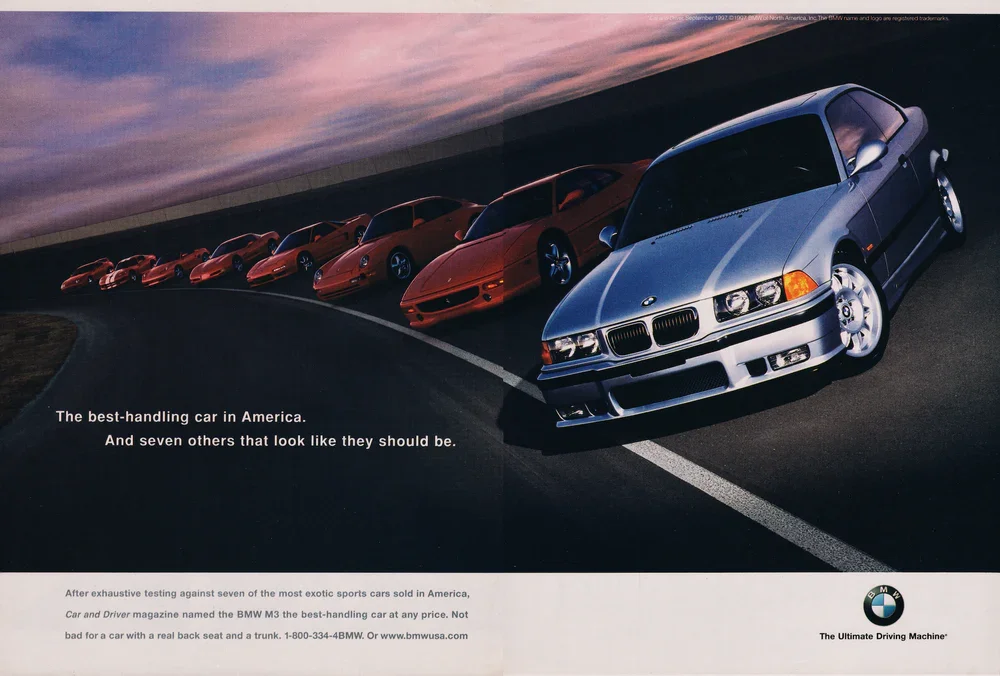
The BMW E36 3 Series has arrived as a fully-fledged enthusiast classic. Prices have stabilised, the community is enormous, and the supply of good examples — while shrinking — is still there if you know what to look for. But buying the wrong one is an expensive lesson. This guide covers everything you need to make a smart purchase: which variants are worth the money, which engines hold up, what to look for on a pre-purchase inspection, and what it actually costs to own one.
The E36 was produced from 1990 to 2000 across four body styles and ten engine variants. Understanding the range is the first step — because a 318i with a tired M40 engine and a 328i with a fresh M52B28 are very different purchases, even if they look identical at a glance.
The E36 Range — Every Variant Explained
Body Styles
Sedan (Limousine) — Most common; best structural rigidity; most practical
Coupe — More desirable; stiffer chassis than convertible; higher subframe risk
Convertible (Cabriolet) — Most subframe-vulnerable due to open body; check reinforcement carefully
Touring (Wagon) — Practical; appreciating in value; limited subframe issues vs coupe/cab
Compact (Hatchback) — Uses E30 rear axle — different rear suspension; lighter; cheaper to buy
All Engines at a Glance
M40B16 — Models: 316i | Displacement: 1.6L 4-cyl | Power: 98 hp | Years: 1990–95 | VANOS: None | Verdict: Slow; timing belt required; avoid unless very cheap
M40B18 — Models: 318i | Displacement: 1.8L 4-cyl | Power: 111 hp | Years: 1990–94 | VANOS: None | Verdict: Timing belt; basic; adequate for a project car
M42B18 — Models: 318i/is | Displacement: 1.8L 4-cyl | Power: 138 hp | Years: 1991–96 | VANOS: None | Verdict: Excellent reliability; chain-driven; best 4-cyl option
M43B18/B19 — Models: 316i/318i | Displacement: 1.8–1.9L 4-cyl | Power: 105–114 hp | Years: 1996–2000 | VANOS: None | Verdict: Reliable but slower than M42; late-model budget choice
M50B20 — Models: 320i | Displacement: 2.0L 6-cyl | Power: 147 hp | Years: 1992–96 | VANOS: None (pre-TU) / Single (TU) | Verdict: Very reliable; no VANOS on early versions; sweet spot
M50B25 — Models: 325i | Displacement: 2.5L 6-cyl | Power: 189 hp | Years: 1992–96 | VANOS: None (pre-TU) / Single (TU) | Verdict: One of the best E36 engines; strong and dependable
M52B20/B25/B28 — Models: 320i/323i/328i | Displacement: 2.0–2.8L 6-cyl | Power: 148–193 hp | Years: 1996–2000 | VANOS: Single | Verdict: VANOS service needed; M52B28 in 328i is the pick of the range
S50B30 (EU) — Models: M3 | Displacement: 3.0L 6-cyl | Power: 282 hp | Years: 1992–95 | VANOS: Single | Verdict: Pure, reliable; the M3 engine
S50B32 (EU) — Models: M3 | Displacement: 3.2L 6-cyl | Power: 321 hp | Years: 1995–99 | VANOS: Double | Verdict: Exceptional; high-revving; double VANOS requires service
S52B32 (US) — Models: M3 | Displacement: 3.2L 6-cyl | Power: 240 hp | Years: 1996–99 | VANOS: Single | Verdict: Detuned for US; still excellent; more torque than EU M3
M41D17 / M51D25 — Models: 318td/tds, 325td/tds | Displacement: 1.7–2.5L diesel | Power: 90–143 hp | Years: 1994–2000 | VANOS: None | Verdict: Practical; good fuel economy; niche but growing market
Which Variant Should You Buy?
Best Daily Driver: 328i with M52B28 (1996–2000)
The 328i is the sweet spot of the E36 range for anyone who wants to use the car regularly. The M52B28 generates 280 Nm of torque — strong and flexible through the rev range — and by the time the 328i was being produced, BMW had ironed out many of the early M52 cooling system issues. A well-maintained 328i will run past 200,000 km. Sedan and touring body styles are your best bets for daily driving; coupes and convertibles are harder to live with day-to-day.
Best Budget Option: 318i with M42B18 (1991–1996)
The M42B18 is the most reliable engine in the E36 range — full stop. It's a twin-cam, four-valve-per-cylinder design with chain drive (no timing belt), no VANOS, and a simple fuel injection system. It won't set your blood pressure rising, but it will run reliably for decades with basic maintenance. A clean 318i or 318is with the M42 is excellent value as a first BMW, a project car, or an affordable entry into the E36 market.
Best for Track Use or Performance: E36 M3
The M3 is in its own category. The S50 and S52 engines are purpose-built performance units that respond well to use and reward maintenance. The European S50B32 is the definitive model — 321 hp, screaming to 7,600 rpm, and feeling unlike anything else in the range. The US S52 is less powerful but carries genuine M3 lineage and can be found at lower prices.
M3 ownership requires accepting additional maintenance overhead: VANOS servicing, subframe reinforcement (essentially mandatory), and higher-quality parts throughout. Treat it as a specialist vehicle and the rewards are significant. Buy one expecting to run it like a non-M car and it will disappoint you.
Best Investment: M3 Coupe (any variant)
E36 M3 values have risen 30–50% over five years and show no sign of reversing. Low-mileage, well-documented examples — particularly Euro-spec S50B32 models — are appreciating. If you want an E36 that's also a financial asset, the M3 coupe is the answer. It won't appreciate at the rate of a Ferrari, but properly maintained, it's unlikely to lose money in the current market.
Underrated Choice: 325i Touring (Wagon)
The E36 touring is rare enough that values are beginning to reflect it. A 325i touring with the M50B25 engine is practical, engaging, and genuinely desirable — it's the kind of car that doesn't exist in modern BMW's line-up anymore. They were produced in low numbers and increasingly sought after.
Pre-Purchase Inspection — What to Check
Never buy an E36 without a proper inspection. This is the checklist. If you're not mechanically confident, pay a BMW specialist $150–$200 for a pre-purchase inspection — it's the best money you'll spend.
Structural — Non-Negotiable
Rear subframe mounting points. Get the car on a lift and inspect all four rear subframe mounts and the trailing arm mounting pockets. Look for radiating cracks, torn metal, and distortion around the bolt holes. Any cracks that haven't been professionally repaired should either be fixed before you buy (ask the seller) or be reflected in the price as a $3,000–$5,000 discount.
Rust. Check sills and rocker panels from underneath. Press firmly along the sill — it should feel solid. Soft spots mean hidden rust. Also check under the rear seats, the boot/trunk floor, spare tyre well, and inside the rear wheel arches. E36s rust predictably in these areas, and structural rust is not repairable at a reasonable cost.
Sunroof drains (if fitted). Blocked sunroof drains cause water to collect in the headliner corners and run down the A-pillars. Look for brown water staining around the interior roof corners and along the sill trim.
Cooling System
Ask for documentation of cooling system service. If none exists for expansion tank, thermostat housing, water pump, and hoses, plan to spend $1,200–$1,800 doing it yourself as soon as you take ownership. Inspect the current expansion tank — look for discolouration, cloudiness, or hairline cracks. Check coolant condition (should be clean and bright). A cold start with thick white exhaust smoke is a head gasket warning.
VANOS Check (M50TU, M52, S50, S52 engines)
Start the engine cold. Listen at idle. A healthy VANOS is silent. A rattle or clatter from 1,000–3,000 rpm that reduces as the engine warms up is a classic VANOS symptom. Budget $800–$1,200 for a rebuild if you hear it. Also check the VANOS oil supply hose — a short rubber hose that cracks and causes VANOS malfunction without the full noise signature.
Test Drive Observations
Does the car pull straight during braking? If not: suspension or brake issue.
Any vibration at highway speed? Centre bearing, propshaft, or wheel balance issue.
Clunking over bumps? Control arm bushings, sway bar end links, or strut top mounts.
Vague steering or excessive play? Power steering rack wear or front end bushings.
Rear end feels loose mid-corner? Subframe movement or trailing arm bushing failure.
Automatic transmission: does it shift smoothly and positively through all gears?
Manual transmission: does the gearshift feel positive, or notchy and reluctant?
Electrical Check
Operate every window. Listen for grinding or slow operation — regulator wear.
Test all central locking from key fob and interior buttons — all doors should respond.
Check instrument cluster for missing pixels (blank sections in speedometer display).
Verify all lights work: headlights (including high beam), brake lights, reverse lights, indicators.
Air conditioning: does it blow cold? Re-gas is $150–$250; compressor failure is $800+.
Market Pricing (2025–2026)
316i / 318i (M40/M43) — $6,500–$12,000 | Entry-level; budget for timing belt on M40
318i/is (M42B18) — $8,000–$15,000 | Best budget choice; M42 reliability premium
320i / 323i — $10,000–$16,000 | M50B20 (pre-1996) more desirable than M52
325i (sedan/coupe) — $11,000–$19,000 | M50B25 excellent; is variants carry premium
325i Touring (wagon) — $14,000–$22,000 | Appreciating; increasingly rare in good condition
325i Cabriolet — $12,000–$20,000 | Sunshine premium; check subframe carefully
328i (sedan/coupe) — $13,000–$22,000 | M52B28 in demand; manual adds 10% premium
M3 — S50B30 (Euro 3.0) — $35,000–$65,000 | Appreciating; check subframe and VANOS history
M3 — S50B32 (Euro 3.2) — $45,000–$85,000 | Most desirable; low-mileage examples over $85k
M3 — S52 (US spec) — $20,000–$35,000 | Good value vs Euro spec; manual only
325td/tds (diesel) — $7,000–$13,000 | M51 diesel; growing interest; practical daily
Premiums apply for: manual transmission (+5–10%), low mileage under 100,000 km (+10–30%), documented full service history (+10–20%), convertible/touring body style (+10–20%), original unmodified condition (+5–15%).
Ownership Costs — What to Budget
Insurance — $800–$1,600 | Non-M: $800–$1,000 / M3: $1,200–$1,600 / Classic policy if over 25 years: $400–$600
Oil changes (2–3/year) — $200–$450 | DIY: $80–$150 per change; specialist: $150–$200
General consumables (filters, plugs, belts) — $300–$600 | Average across a maintenance year
Brake pads and rotors (typical year) — $400–$800 | If needed; biennial for average use
Unexpected repairs (budget reserve) — $1,000–$2,500 | Window regulators, bushings, sensors, electrical
Total annual estimate — $2,700–$5,950 | Non-M models at lower end; M3 or high-mileage cars at top
The biggest single expense in any year is likely to be deferred maintenance catching up — a cooling system replacement ($1,200–$1,800), subframe reinforcement ($2,500–$5,000), or VANOS service ($800–$1,200). If you buy a car with complete service history showing these items have been done, your annual costs will be closer to the lower end of the range.
DIY-Friendliness Rating: 8/10
The E36 is one of the most DIY-accessible BMW platforms ever made. There are no electronic throttle complications, the engine bay is spacious, and decades of community documentation means almost every job has been filmed, photographed, and written up. An owner who can do their own oil changes, brake pads, and suspension work will save $2,000–$3,000 per year compared to paying specialist rates for everything.
The jobs that really do require a specialist — VANOS rebuilds, subframe reinforcement, differential work, and engine head work — are the exception rather than the rule. Everything else on an E36 is within reach of a motivated home mechanic with basic tools.
Highly recommended resources: BimmerFest.com (BMW forums, extensive E36 section), r/e36 on Reddit (active community), YouTube DIY channels, and Peake Research or similar OBD readers for diagnostics.
Modifications — What's Worth Doing
The E36 is a favourite platform for modification because the factory setup is already well-balanced and sensible upgrades produce meaningful results without breaking the car.
Best first modifications: Front and rear sway bars ($300–$700 for a set), quality replacement dampers or coilovers if the originals are shot ($800–$2,000), and an alignment after any suspension work. These three things transform handling without sacrificing street usability. An exhaust ($400–$800 for a reputable brand cat-back) adds sound and a small power gain.
Worth doing when you're in there already: When replacing cooling system components, consider upgrading to the metal thermostat housing available from specialist suppliers — it eliminates the plastic housing failure point permanently. Similarly, when doing bushings, polyurethane front control arm bushings offer improved steering feel with a modest ride trade-off.
Engine swaps: The M52 swap into M40 or M42 cars is well-documented and genuinely worthwhile — you effectively convert a 318i into a 325i or 328i. Budget $2,000–$4,000 for the swap including parts and labour. The M54 swap is more complex but delivers E46 performance in a lighter E36 chassis.
Final Verdict — Should You Buy an E36?
Yes — with eyes open and a realistic budget. The E36 is a genuinely great driver's car that happens to also be affordable relative to its performance and driving experience. It's not a car for someone who wants to set and forget their vehicle. It needs maintenance, it will have quirks, and it will occasionally need money spent on it.
But for someone who enjoys being involved with their vehicle — doing some of their own work, understanding what's going on mechanically, taking satisfaction in a well-sorted, well-maintained car — the E36 is an exceptional choice. The community is knowledgeable and generous, parts availability is still excellent, and the cars are rewarding to drive in a way that modern equivalents simply aren't.
Buy the best example you can afford. Prioritise service history over mileage. Get a pre-purchase inspection. Budget for a cooling system refresh and subframe inspection immediately after purchase. Do these things and an E36 will give you years of satisfaction.
For accurate torque specs when you're doing your own maintenance, check the BMW E36 torque specs page — every system covered, downloadable spreadsheet included.
Looking at newer 3 Series? The BMW E46 torque specs page covers the successor generation in the same comprehensive format.
A Note on This Guide
Prices, availability, and market conditions change over time — figures in this guide are for reference only and may not reflect current market values in your region. Always have any used vehicle independently inspected by a qualified mechanic before purchase. This guide does not constitute professional advice. Proceed at your own risk.